Module 9 of 17

Proper Exercise Technique

Builds a full Chapter 9 learning path around proper exercise technique, trainer feedback, cueing, lower-body control, rowing and pressing mechanics, and Figure 9.1 exercise examples.

Overview

Module 9 connects proper exercise technique to program design. Learners read the complete chapter, review Figure 9.1 exercise images, use representative technique videos, and practice choosing feedback and cueing strategies.

Read the full Chapter 9 technique chapter first, then use the Figure 9.1 image gallery, video support, flipcards, case activity, and quiz to apply the cueing and movement-quality concepts.

Learning assets

11

Required items

6

Learning objectives

  • Explain why proper exercise technique is foundational for safe and effective programming.
  • Describe how trainer feedback supports proper form during familiarization, primary exercises, moderate-to-heavy loading, and form changes.
  • Differentiate verbal, tactile, visual, and technology-assisted feedback.
  • Identify common lower-body technique characteristics for squats, deadlifts, lunges, hip thrusts, and leg press patterns.
  • Identify common rowing and chest press characteristics related to chin, shoulders, torso, and shoulder position.

Core instruction

Preserve the chapter, then practice applying it

Chapter 9 explains why proper exercise technique and progressive programming must work together.

The full reading is preserved in sequence behind the chapter button, including cueing sections, movement characteristics, Figure 9.1, and all fourteen source images.

The callouts, flipcards, videos, case, and quiz are supplemental practice supports.

Why this matters

Technique is where program design becomes movement. Learners need to connect feedback, cueing, lower-body control, pull and press mechanics, and exercise images before deciding whether a movement is ready to progress.

Book chapter

Chapter 9: Proper Exercise Technique

Required full chapter reading

The full Chapter 9 reading is embedded here. Open it when you are ready to work through the complete source chapter, cueing guidance, movement characteristics, and Figure 9.1 exercise images.

This chapter connects proper exercise technique with programming quality, trainer feedback, cueing methods, and common characteristics of lower-body, rowing, and chest press movements.

Use the show/hide control to read the full chapter and connect the source wording to the supplemental learning supports.

Technique and progressive programming must work together.

Feedback is emphasized during familiarization, primary exercises, heavy loading, and visible form changes.

Show Full Chapter Reading

Full chapter reading

Chapter 9: Proper Exercise Technique

Introduction

Proper exercise technique is among the most important components of program design. A proper, progressive, total body, Flexible Linear Periodization approach has little value in the absence of proper exercise technique – they go hand in hand.

It is recommended that prior to viewing the videos, the reader reviews the common characteristics and attributes of proper and improper form discussed in Chapter 4 be reviewed before proceeding. The reader will be directed to the exercise technique videos located at www.MRFInstitute.org.

Feedback and cueing:

When individuals are being trained by a professional trainer, and to ensure proper form for every exercise, it is imperative that the trainer continually provide the client feedback. During the Familiarization Phase (i.e., initial program design), where a primary goal is to teach proper form and assist in developing mind-body connections, the trainer should provide feedback on every set of every exercise. When the client shows proficiency, the feedback can be slightly reduced, but should still occur as a part of every session. In a perfect world feedback should be given every repetition of every set in every session, but this is unrealistic. It is at the trainer’s discretion to determine how often feedback should be given, but generally speaking:

  • All sets where primary exercises (cleans, squats, hip hinge [e.g., deadlifts and hip thrusts], push, pull, and press) are being performed, feedback should be included.
  • All sets with moderate to heavy loads (i.e., 1 to 8 repetition range) taken to “at or near” muscle failure should include regular feedback.
  • Complex, multi-joint, metabolically fatiguing exercises require regular feedback.
  • When the trainer notices a break or a potential break in form, feedback should be provided.
  • When a trainer notices a lack of focus feedback should be provided.

Trainer Feedback Decision Flow

  1. 1Watch the set
  2. 2Identify the movement-quality need
  3. 3Select verbal, tactile, visual, or technology feedback
  4. 4Cue without disrupting safety or focus
  5. 5Reassess the next repetition or set

This flow supports the feedback paragraph above. It does not replace the source wording.

Types of Cueing Feedback

Types of feedback include kinesthetic (internal – such as the feeling of a stretch or holding a weight) and tactile (external – such as touching a body part to help provide a mind-body connection):

  • Verbal –kinesthetic.
  • Touching – tactile.
  • Visual (e.g., the use of mirrors and video) – kinesthetic.
  • Other technology (e.g., accelerometers) – kinesthetic and tactile.

Cueing Feedback Types

Use these categories as a quick review after reading the source cueing-feedback section.

Verbal

Kinesthetic feedback delivered through spoken coaching cues.

Touching

Tactile feedback used to support a mind-body connection when appropriate.

Visual

Kinesthetic feedback through mirrors, video, and movement observation.

Technology

Feedback tools such as accelerometers that can provide kinesthetic and tactile information.

Common examples of verbal cues include:

  • “Initiate the movement from” the prime mover(s).
  • “Lift with velocity, lower with control.”
  • “Retract your chin to keep your neck in line with your spine.”
  • “Maintain your natural shoulder slope and keep your neck as relaxed as possible.”
  • “Chest out, shoulders back.”
  • “Watch your hips in the mirror and don’t allow yourself to shift to the side.”
  • “Maintain a mind-body connection with your feet and don’t allow your body weight to shift to your forefoot.”

Tactile cues

Tactile cues are appropriate in certain situations (e.g., tapping a client’s latissimus dorsi to remind them to focus on that muscle group during rowing exercises), and inappropriate in certain situations (i.e., a trainer should never tap a client’s glutes in any situation). It is at the trainer’s discretion when to use tactile cues, and to understand that they are an important component of feedback that should not be overlooked or disregarded.

Visual cueing

Whenever possible and appropriate, visual cueing in the form of mirrors and video feedback should be provided to the client, especially with multi-joint, primary exercises. Slow motion and normal speed video feedback can be invaluable, especially with exercises or particular angles where the client could not otherwise see themselves.

Common characteristics of primary lower body exercises, and pull and press movements:

More details will be provided within the corresponding videos found at www.MRFInstitute.org, but for clarity and ease of understanding the concept of proper form it is important to understand some common characteristics. For example:

Lower body multi-joint exercises:

When performing all multi-joint lower body exercises (i.e., squats, deadlifts, hip thrust, multi-directional lunge, leg press):

  • At the foot-ankle complex, there should be little to no frontal plane (i.e., side-to-side) movement. The foot and ankle should be stable, and all movement should occur in the sagittal plane (front-to-back).
  • Weight distribution at the foot should never shift toward the forefoot. Individuals should be instructed to lower body weight toward the mid-to-hindfoot and to drive the mid-to-hindfoot into the ground to ascend back into starting position.
  • There should be little to no frontal plane movement at the knee during the exercise.
  • In most cases, depth should be maximal, as determined by hip mobility and the ability to maintain a neutral lumbar spine. The “butt wink” should generally be avoided.
  • The core should be braced, spine neutral, chest out, and shoulders back.

Lower-Body Technique Checklist

This checklist restates the lower-body source characteristics as quick review checkpoints.

Foot and ankle

Little to no frontal-plane movement; stable foot and ankle.

Weight distribution

Avoid shifting toward the forefoot; drive through the mid-to-hindfoot.

Knee control

Little to no frontal-plane knee movement during the exercise.

Depth

Use maximal depth as allowed by hip mobility and neutral lumbar spine.

Brace and posture

Core braced, spine neutral, chest out, and shoulders back.

Multi-joint rowing and chest press movements:

No matter the body position, whether standing, sitting, kneeling, lying, or suspended (i.e., suspension rows or presses), the exerciser should:

  • Maintain a neutral chin (approximately 10 degrees of cervical extension or flexion is acceptable in most situations, providing the neck is not strained).
  • Avoid forward head posture (retract the chin).
  • Maintain natural shoulder slope (shoulders should not move towards the ear during the exercise).
  • “Super-glue” the torso in space so that the only the arms are moving during the exercise.
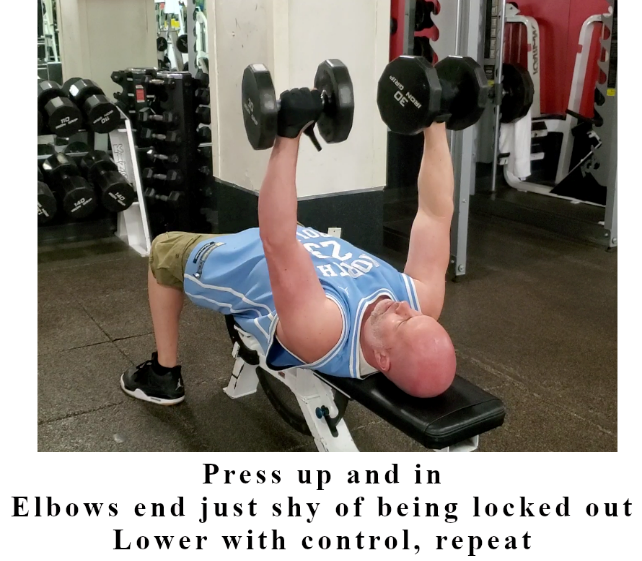
  • During chest press exercises, the exerciser should avoid abducting the shoulder beyond 70 degrees (i.e., avoid flaring the upper arm away from the torso excessively) and to avoid going beyond a depth of 110 degrees of shoulder horizontal abduction.

Pull and Press Technique Checklist

Use this supplemental checklist after reading the source rowing and chest press characteristics.

Neutral chin

Maintain a neutral chin while keeping the neck unstrained.

Forward head posture

Avoid forward head posture by retracting the chin.

Shoulder slope

Maintain natural shoulder slope rather than shrugging toward the ears.

Stable torso

Keep the torso fixed so the arms are the moving segments.

Chest press position

Avoid excessive shoulder abduction and excessive press depth.

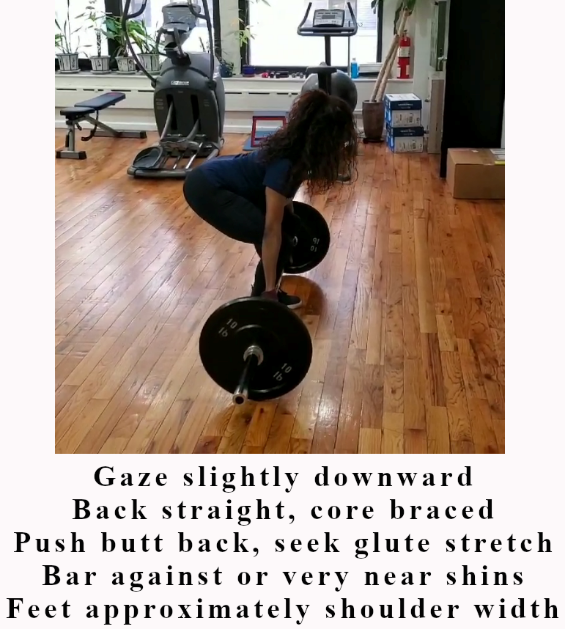
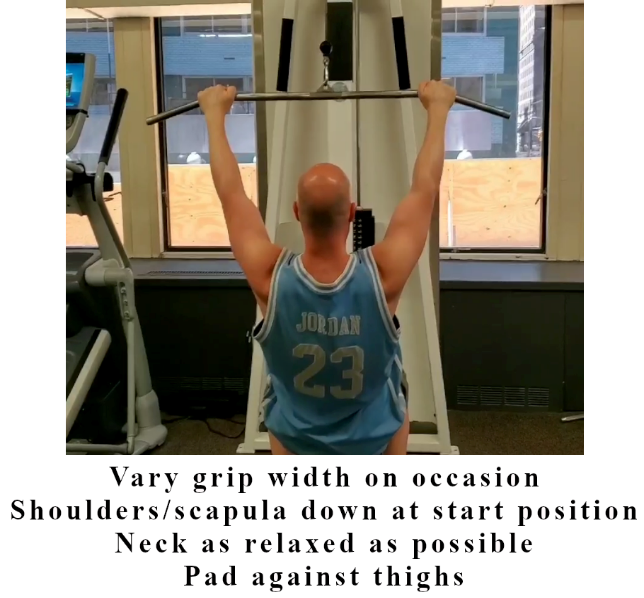
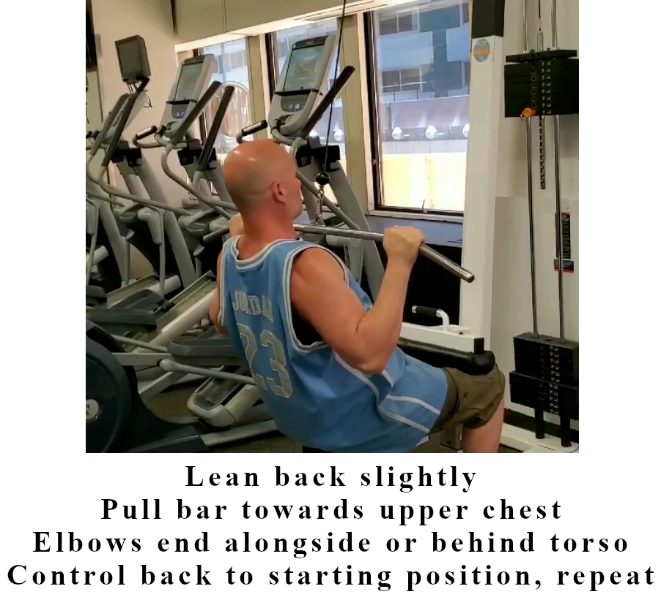
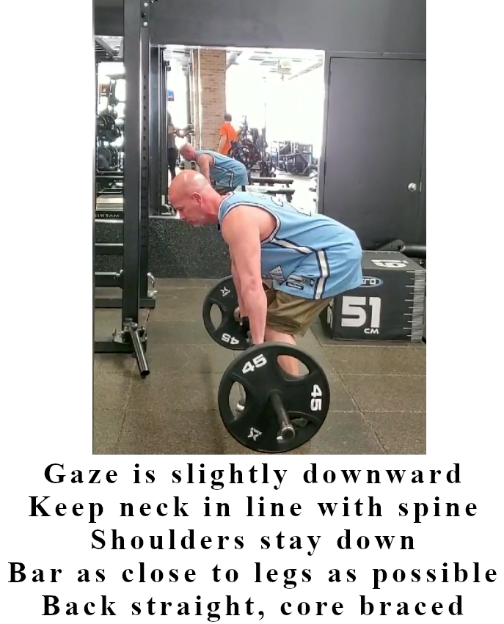
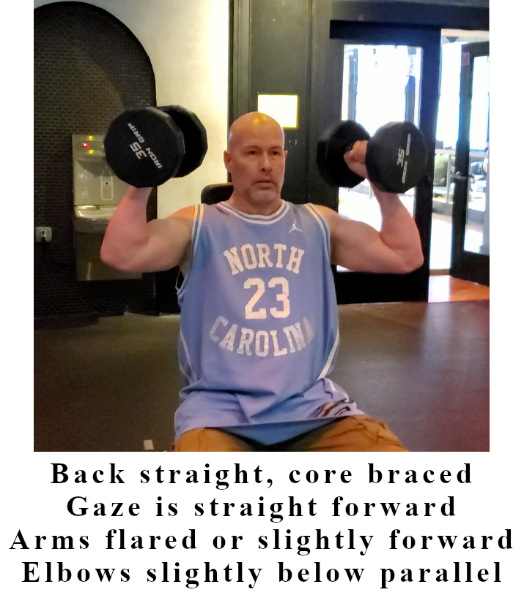
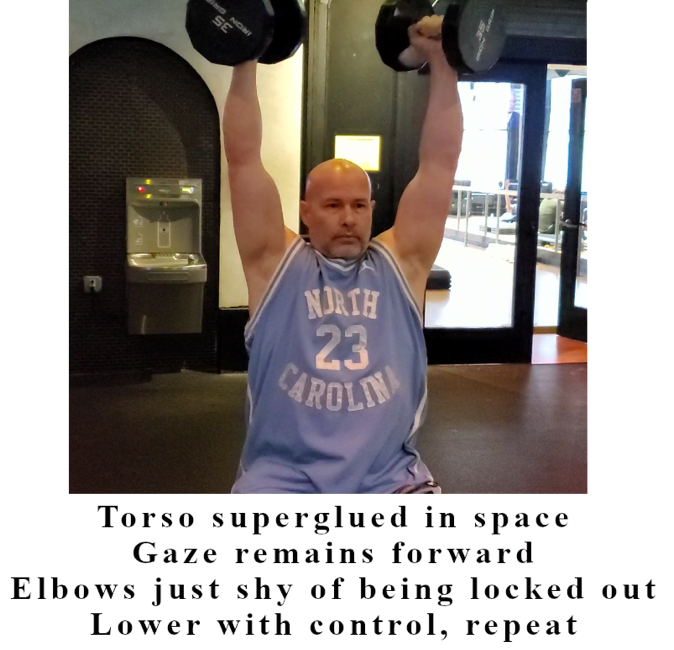
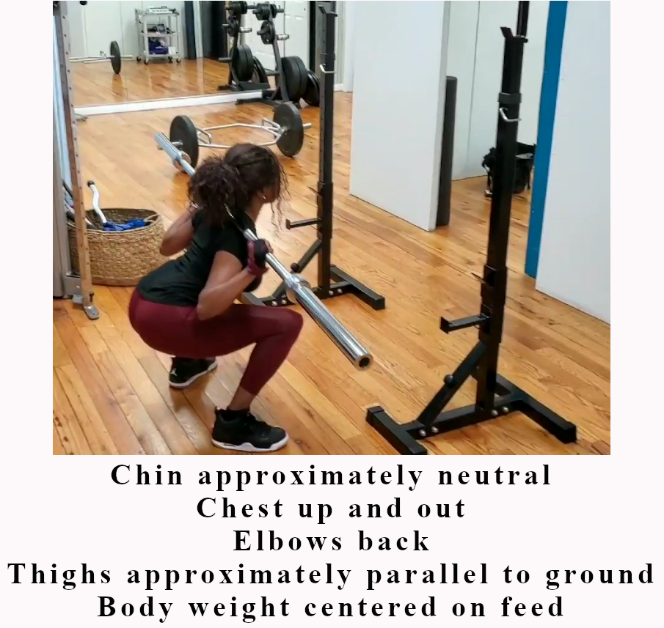
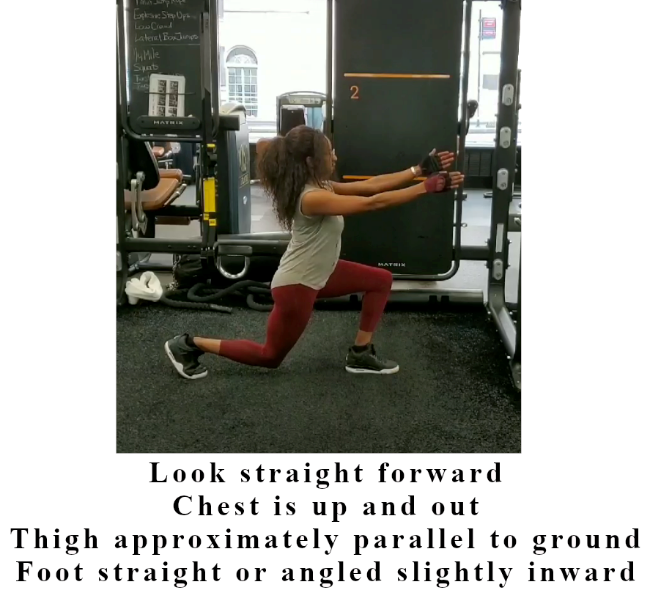
While the reader is directed to instructional videos as the primary source to learn proper exercise technique (www.MRFInstitute.org), below are pictures of common exercises and basic descriptions of proper form. Figure 9.1 Proper Technique for Various Exercises.

Figure 9.1: Proper Technique for Various Exercises.

Barbell Squat

Barbell Squat
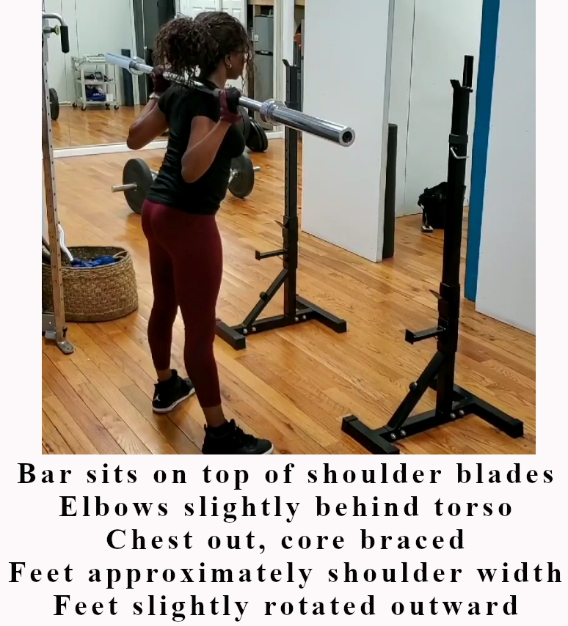
Barbell squat setup position from Figure 9.1.
Barbell squat setup

Barbell squat lowered position from Figure 9.1.

Barbell squat lowered position

Figure 9.1: Proper Technique for Various Exercises.

Barbell Deadlift

Barbell Deadlift

Barbell deadlift starting position from Figure 9.1.
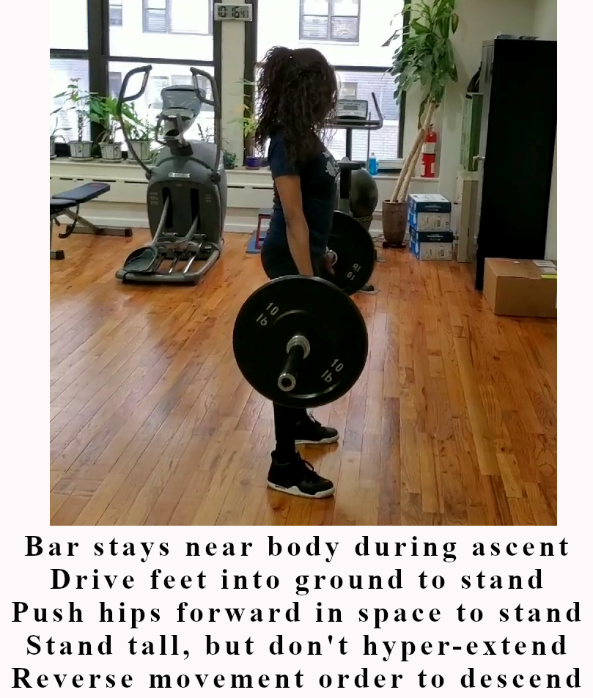
Barbell deadlift starting position

Barbell deadlift standing position from Figure 9.1.

Barbell deadlift standing position

Figure 9.1: Proper Technique for Various Exercises.

Lunge

Depending on type of lunge, push forward, backward, or vertically, with front foot and leg to ascend back into starting position

Lunge
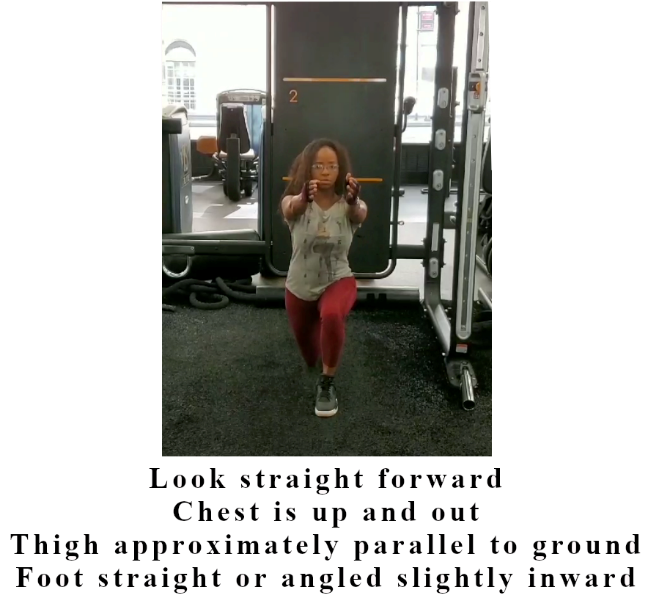
Lunge setup position from Figure 9.1.
Lunge setup

Lunge lowered position from Figure 9.1.

Lunge lowered position

Figure 9.1: Proper Technique for Various Exercises.

Lat Pulldown

Lat Pulldown

Lat pulldown starting position from Figure 9.1.

Lat pulldown start

Lat pulldown pulling position from Figure 9.1.

Lat pulldown pull

Figure 9.1: Proper Technique for Various Exercises.

Barbell Row

Barbell Row

Barbell row setup position from Figure 9.1.
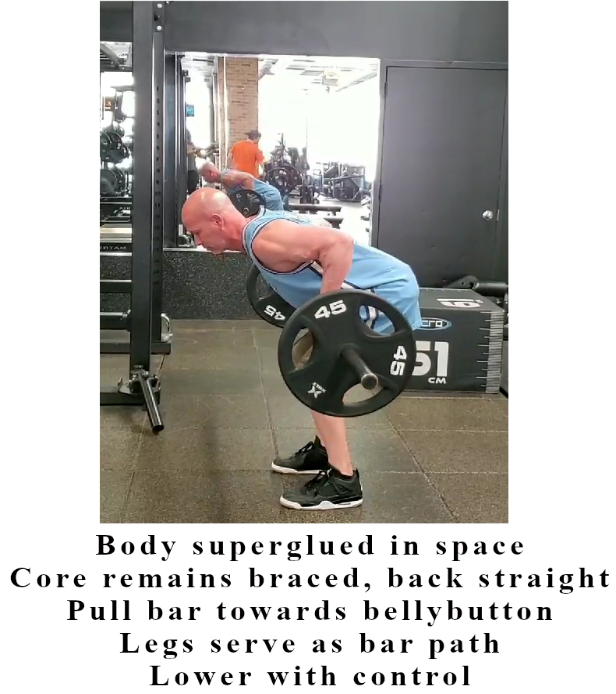
Barbell row setup

Barbell row pulling position from Figure 9.1.

Barbell row pull

Figure 9.1: Proper Technique for Various Exercises.

Dumbbell Chest Press

Dumbbell Chest Press
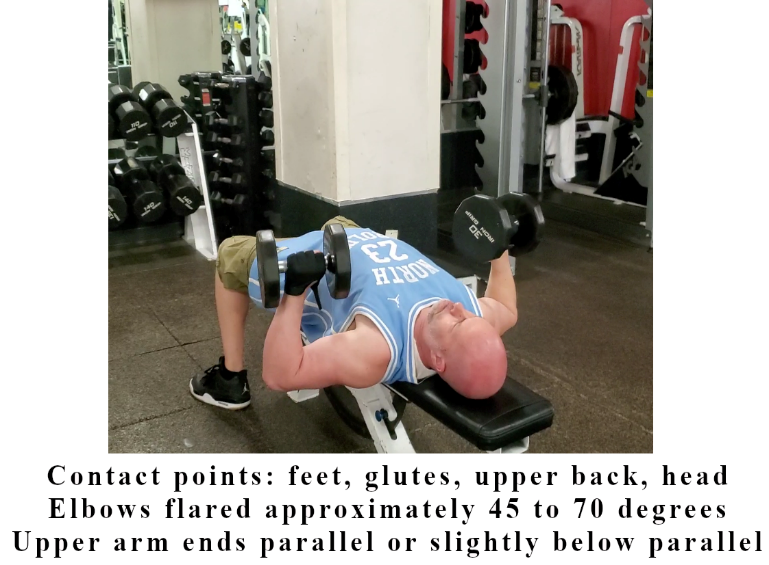
Dumbbell chest press lowered position from Figure 9.1.
Dumbbell chest press lowered position

Dumbbell chest press extended position from Figure 9.1.

Dumbbell chest press extended position

Figure 9.1: Proper Technique for Various Exercises.

Shoulders

Shoulders

Shoulder press starting position from Figure 9.1.

Shoulder press start

Shoulder press extended position from Figure 9.1.

Shoulder press extended position

Figure 9.1: Proper Technique for Various Exercises.

Video / media support

Squat Assessment and Goblet Squat

Use this lesson to reinforce squat setup, lower-body control, range of motion, and exercise selection decisions.

This video supports the Chapter 9 squat technique content.

Watch video

Barbell Back Squat and Front Squat

Use this lesson to reinforce barbell squat technique, setup, and loading readiness.

This video supports the Figure 9.1 barbell squat images.

Watch video

Conventional, Sumo, and Trap Bar Deadlifts

Use this lesson to compare deadlift setup options, trunk position, and hinge control.

This video supports the Figure 9.1 deadlift images.

Watch video

Stationary, Forward, and Backward Lunge

Use this lesson to reinforce lunge control, foot position, and lower-body alignment.

This video supports the Figure 9.1 lunge images.

Watch video

Lat Pulldown and Seated Row

Use this lesson to reinforce pulling setup, neutral chin, shoulder position, and torso stability.

This video supports the Chapter 9 pulling movement content.

Watch video

Flat and Incline Dumbbell Press

Use this lesson to reinforce pressing setup, shoulder position, and controlled range of motion.

This video supports the Figure 9.1 dumbbell chest press images.

Watch video

Overhead Dumbbell Press and Upright Row

Use this lesson to reinforce shoulder exercise setup, control, and upper-body positioning.

This video supports the Figure 9.1 shoulder images.

Watch video

Interactive recall

Cueing and Feedback Decisions

Tap each card to review how the chapter frames feedback frequency and cueing choices.

Interactive recall

Technique Checkpoints

Use these cards to practice the lower-body, pulling, and pressing characteristics from the chapter.

Applied case study

Case application: choosing feedback and cueing

A client in the Familiarization Phase is practicing squats, lunges, rows, and dumbbell chest presses. During the session, their weight shifts toward the forefoot in squats, the knee drifts side to side during lunges, the shoulders rise toward the ears during rows, and the upper arm flares excessively during chest press.

How often should feedback be provided in this session?

Because this is the Familiarization Phase and includes primary exercises, feedback should be frequent across the sets while the client learns form.

Which lower-body technique errors should be addressed?

Address the forefoot weight shift during squats and the frontal-plane knee movement during lunges.

Which rowing and pressing characteristics should be addressed?

Address shoulders moving toward the ears during rows and excessive shoulder abduction during chest press.

Which cueing types could be appropriate?

Use verbal cues first, visual feedback through a mirror or video when useful, and tactile cueing only when appropriate and professionally bounded.

What should happen after cueing?

Observe the next repetitions or set to determine whether the cue improved movement quality or whether the exercise needs adjustment.

This activity practices exercise-technique feedback and cueing decisions. It does not replace individualized medical, rehabilitation, or clinical evaluation.

Knowledge check

Module 9 quiz

10-question quiz

Answered: 0/10

Current score: 0/10

Submit to review your score and feedback.

Public preview mode: quiz interaction stays on this device and is not saved.

1. Proper exercise technique is one of the most important components of program design.

2. During the Familiarization Phase, what should the trainer generally provide?

3. Which cueing type is tactile feedback?

4. Visual cueing may include mirrors and video feedback.

5. For lower-body multi-joint exercises, weight should shift toward the forefoot during the movement.

6. Which lower-body checkpoint is emphasized in the chapter?

7. In most lower-body cases, depth is determined by hip mobility and the ability to maintain a neutral lumbar spine.

8. For rowing and chest press movements, what should happen to the torso?

9. During chest press exercises, the exerciser should avoid excessive shoulder abduction and excessive depth.

10. If a trainer notices a potential break in form, what should happen?

Answer all questions, then submit to display the final score.

A score of 7/10 or higher is required for saved module completion.

Submit the quiz to see your score and review feedback.

Professional reflection

Choose one exercise from Figure 9.1 and describe the feedback or cueing you would use if technique changed during the set.

Use this reflection to prepare your professional reasoning before moving on.

Takeaways and next step

Proper exercise technique is central to safe and useful program design.

Feedback should be frequent when clients are learning, performing primary exercises, or showing form changes.

Cueing method should match the technique issue and professional context.

Figure 9.1 organizes seven exercise examples that support the lower-body, pulling, pressing, and shoulder technique concepts.

When you have completed the chapter, Figure 9.1 image review, video support, case prompt, and learning check, use the saved-progress panel to mark Module 9 complete and continue to Module 10.