Full chapter reading
Chapter 8: Example Resistance Training Program Design
Introduction
This chapter provides practical examples of resistance training programs, emphasizing how to design sessions, weeks, and phases. It bridges theory and practice, showing how universal principles manifest in real-world settings.
The implementation of a resistance training program is best understood when described as how each session is designed (i.e., scope of a session); how each session fits within the scope of a week; how each week fits within the scope of a phase; and how each phase fits within the scope of a cycle. Below are descriptions of each:
Scope of a Session
A recommended framework for every session includes:
- 1.A readiness to train screen.
- 2.Trigger point release.
- 3.Dynamic warm-up.
- 4.Include balance and force absorption exercises (if applicable).
- 5.Core Training.
- 6.Flexible Periodization Workout.
Session Framework
- 1Readiness to train
- 2Trigger point release
- 3Dynamic warm-up
- 4Balance and force absorption as applicable
- 5Core training
- 6Flexible periodization workout
This visual supports the session framework list above.
Readiness to Train
Prior to every session it is imperative that a series of questions are asked – a concept known as “Readiness to train.” This determines the “Flexible” part of Flexible Linear Periodization (Kraemer, 2007). The answers are used to decide how to adjust the exercise selection, volume, intensity, or duration of the session.
Table 8.1: Readiness to Train Questions
Use these questions before each session to determine the flexible part of flexible periodization.
Question 1
How do you feel?
Question 2
How did your body respond to the last session?
Question 3
When and what did you last eat?
Question 4
Are you hydrated?
Question 5
Have you taken any medications I should be aware of?
Question 6
Is there anything else you’d like me to know prior to the workout?
As explain in Chapter 6, if a “heavy” day is scheduled, but the exerciser answers that they may be coming down with a cold, didn’t sleep well, or is very stressed about work (as examples), it would be prudent to reduce volume and intensity for the session.
Alternatively, if a “lighter” session was planned but the exerciser comes in feeling energized and motivated, session volume and intensity can be increased.
Trigger Point Release
Following the Readiness to Train screening, the inclusion of trigger point release in a session is determined by the following considerations:
- 1.Individual Preference: The participant's preference for incorporating trigger point release into their routine. Some may opt to perform it independently before or after the session rather than during.
- 2.Trigger Point Necessity: The presence and severity of trigger points. While uncommon, some individuals may have minimal or no significant trigger points, making this intervention unnecessary.
This personalized approach ensures the session remains aligned with the individual's needs and goals.
Table 8.2: Trigger Point Release Example for the Lower Body
| Body Part | Release Tool | Duration |
|---|---|---|
| Glutes | Lacrosse ball | 1 minute |
| IT Band | Foam roller | 1 minute |
| Quadriceps | Foam roller | 1 minute |
| Calves | Foam roller | 1 minute |
Dynamic Warm-up
Following the trigger point release portion of the session the exerciser should perform a series of mobility drills, known as a dynamic warm-up (Bishop, 2003). The purpose for the dynamic warm-up includes:
- 1.To begin to activate the muscles
- 2.Slightly increase heart rate and corresponding blood flow
- 3.Use as an opportunity to maintain or improve static and dynamic balance, force absorption, or include therapeutic exercise such as unstable surface exercises
The variety of dynamic warm-up movements and activities can feel overwhelming when deciding which combination to use. However, fitness professionals should remember that the primary goal of the session is to enhance strength and conditioning. While a dynamic warm-up is essential for preparing the body, it should be concise, purposeful, and not overemphasized. Keep it simple, structured, and aligned with the session's objectives to ensure it supports, rather than detracts from, the main workout.
For the lower body, movements should be selected to activate the quadriceps, hamstrings, glutes, adductors, and abductors (Table 8.3). Spine mobilization can be achieved with movements such as thoracic extension and rotation (Table 8.3).
The upper body does not typically need specific dynamic movements. The chest and back are sufficiently activated during the warm-up sets performed prior to the strength training working sets. If shoulders are being worked separately, consideration should be given to performing shoulder mobility drills (Table 8.3). However, if shoulders are trained in the same session as chest and back, they will be adequately activated from those exercises.
Table 8.3: Dynamic Movements by Body Part
| Body Part | Movement | Repetitions |
|---|---|---|
| Hamstrings | Front leg swings | 10 to 15 reps |
| Adductors/Groin | Side leg swings | 10 to 15 reps |
| Quadriceps | Butt kicks | 10 to 15 reps |
| Hip flexors | High knees | 10 to 15 reps |
| Piriformis | Half pigeon stretch with 3-sec hold | 8 to 10 reps |
| Glutes | High step | 6 to 8 reps |
| Thoracic spine | Thoracic rotation | 6 to 8 reps |
| Shoulders | Wall Slides | 8 to 10 reps |
Note: Most of these dynamic movements should be used each session unless the session is only an upper body training session.
Balance and Force Absorption Exercises
Balance (static and/or dynamic) and force absorption exercises should also be included, although not necessarily every session (Table 8.4 and 8.5).
Table 8.4: Static and Dynamic Balance Exercises
| Type | Exercise |
|---|---|
| Static | Single leg on Airex pad |
| Dynamic | Backwards jog |
| Dynamic | Grapevine jog |
Note: The inclusion of balance exercises is evaluated on a session-by-session basis. While balance exercises should be a regular part of a comprehensive program, they do not need to be included in every session. Balance training is especially crucial for older adults or individuals with balance challenges and should be specifically addressed on a weekly basis. This can be done as standalone training or incorporated into aerobic and muscle-strengthening activities.
Table 8.5: Force Absorption Exercises
| Exercise | Repetitions |
|---|---|
| 6-inch Reebok Step step-down | 10 each side |
| 6–12-inch box jumps | 10 reps |
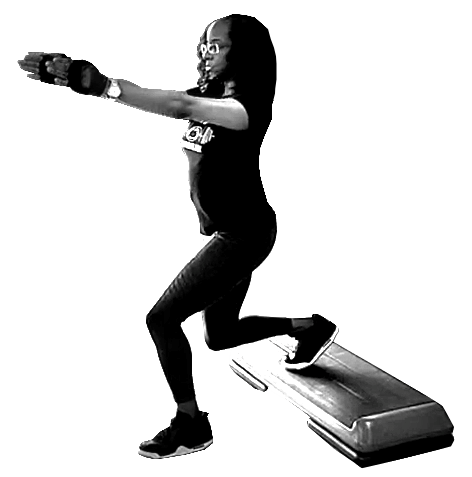
Note: The inclusion of force absorption exercises should be assessed on a session-by-session basis. While these exercises should be regularly incorporated into a well-rounded program, they are not required in every session.
Examples of lower-body force absorption exercises include hops, jumps, and bounds. For the upper body, options include medicine ball catches and plyometric push-ups. These movements are integral to improving joint stability, muscle control, and overall athletic performance.
Approximately 7 to 10 minutes should be spent performing the dynamic warm-up part of the session.
Core Training
Following the dynamic warm-up, exercises should be chosen that activate the core. There are multiple definitions and views as to what constitutes the “core,” with no agreed upon standard. Here we define the core as having a “top,” (the diaphragm), a “bottom,” (the pelvic floor), and the musculature of the hips and torso (Faries, 2007). Ideally, exercises should be chosen to train the:
- 1.Low back and spinal erectors.
- 2.Adductors/groin.
- 3.Abductors.
- 4.Abdominals (front and side).
FYI: Care should be taken to avoid excessive fatigue during the core warm-up, as this can negatively impact the performance of primary exercises such as squats, deadlifts, and lunges. Intensity should remain within the "moderate to moderately hard" range, avoiding "hard" and "very hard" levels.
Additionally, excessive volume in core training should be avoided. While isolating the core with direct exercises is important, most core musculature is progressively strengthened through many primary compound exercises (Martuscello, 2013). These primary movements not only enhance core strength but also play a significant role in preventing and reducing musculoskeletal pain, such as low back pain, and should remain the program's primary focus.
Direct core training does provide muscular endurance benefits, particularly through extended time-under-tension (e.g., holding a plank for 60 seconds). However, higher-intensity core training aimed at building endurance should be scheduled after primary exercises are completed.
Excessive emphasis on direct core training at the expense of adequate volume for essential compound movements leads to an inefficient program. Within sessions, direct core training should be minimal and treated as part of the warm-up. Additional core work can be incorporated either outside the session or toward its conclusion.
Core Muscular Programming Concepts and Guidelines
The core includes larger, global musculature and smaller, intrinsic musculature. To create balance and for ease of program design, sessions should alternate between a core “movers” session and a core “stabilizers” session. The “movers” session focuses on exercises that require concentric torso contractions. The “stabilizers” session involves isometric torso contractions, except for exercises that target the low back and spinal erectors. Tables 8.6 and 8.7 charts below provide examples of stabilizers and movers sessions. Exercisers should rotate back and forth at a 1:1 ratio, with one to two sets per core body part per session.
Table 8.6: Core “Movers” Session Example
| Body Part | Exercise | Time or Reps |
|---|---|---|
| Low back | Prone low back extension-hold | Hold for time |
| Adductors | Adductor machine or Side-lying leg raise (bottom leg) | 10 to 15 reps |
| Abductors | Side-lying leg raise (top leg) or cable abduction | 10 to 15 reps |
| Front abdominals | Crunch on floor or crunch on stability ball | 12 to 20 reps |
| Side abdominals | Cable torso rotation from various angles (high-low, low-high) | 12 to 20 reps |
Table 8.7: Core “Stabilizers” Session Example
| Body Part | Exercise | Time or Reps |
|---|---|---|
| Low back | Quadruped or prone swimmer | 8 to 15 reps |
| Adductors | Adductor machine or Pilates magic circle | 10 to 15 reps |
| Abductors | Side-lying clam or monster walk | 10 to 15 reps |
| Front abdominals | Plank or Pilates mat exercise | Hold for time |
| Side abdominals | Side plank or modified cable Paloff press | Hold for time |
Note: the core warm-up should take no more than 10 minutes to complete.
Resistance Training Workout
Following the core warm-up, the session moves to the actual workout. As discussed in Chapter 6, programs should revolve around primary exercises (Table 8.8) to maximize potential, optimize efficiency, and help individuals meet their goals. At a minimum, there should be at least one primary exercise for the lower body, upper body pressing, and upper body pulling
Primary exercises for the lower body include squat variations, deadlift variations, multi-directional lunges, hip thrust, and leg press. For the upper body, primary exercises include pulling to train the back (e.g., pull-ups, lat pulldown, seated row, cable row, dumbbell row), pressing for the chest (e.g., bench or dumbbell press variations, push-up variations), and pressing for the shoulders (e.g., standing or seated overhead press, landmine press).
Table 8.8: Primary Exercises
| Lower Body | Upper Body |
|---|---|
| Squat variations | Pulldown and Pull-up variations |
| Deadlift variations | Row variations (seated, cable, dumbbell |
| Multi-directional lunges | Chest press variations (and push-ups) |
| Hip Thrust | Shoulder press variations (standing, seated, landmine) |
| Leg Press | |
| Step Ups |
Exercise selection is at the fitness professional’s discretion and should be based on the ability to perform the movements with proper form.
People should not be expected to perform any exercise or movement they are apprehensive about performing.
When possible, exercise selection should correspond closely with “heavy” or “hard” days and “moderate” or “light” days. Heavy sessions are characterized by sets that are in closer proximity to muscle failure (e.g., 8.5 to 10 RPE). Light to moderate sessions are characterized by working sets that are slightly further away from muscle failure (e.g., 7 to 8 RPE).
Heavy vs. Light to Moderate Session Emphasis
Heavy or hard session
Sets are closer to muscle failure and should usually pair with bilateral exercises.
- Higher intensity
- Closer proximity to failure
- Bilateral emphasis
- More conservative readiness check
Light to moderate session
Sets terminate farther from failure and can emphasize unilateral exercise choices.
- Lower to moderate intensity
- More repetitions in reserve
- Unilateral emphasis
- Useful for asymmetry work
For example, during heavy day training the individual may perform bilateral exercises such as:
- 1.Lower body: squats and deadlifts.
- 2.Upper body pulling: Lat pulldown or seated row.
- 3.Upper body pressing: barbell or dumbbell press exercises or push-ups.
When possible, exercise selection for light and moderate days should shift toward unilateral exercises, such as:
- 1.Lower body: multi-directional lunges or single-leg leg press
- 2.Repetition Range Influence on Shoulder Exercises:The repetition range influences exercise selection for shoulder strengthening. In strength-endurance repetition ranges (i.e., 12 repetitions per set and above) emphasis should be placed on single-joint movements and rotator cuff strengthening. For example, lateral raises, scaptions, reverse fly variations, face pulls, and shoulder external rotation variations. This prepares the shoulders for the lower, strength repetition ranges (i.e., 10 repetitions per set and below) where the emphasis shifts towards compound movements.Repetition Range Influence on Shoulder Exercises:The repetition range influences exercise selection for shoulder strengthening. In strength-endurance repetition ranges (i.e., 12 repetitions per set and above) emphasis should be placed on single-joint movements and rotator cuff strengthening. For example, lateral raises, scaptions, reverse fly variations, face pulls, and shoulder external rotation variations. This prepares the shoulders for the lower, strength repetition ranges (i.e., 10 repetitions per set and below) where the emphasis shifts towards compound movements.Upper body pulling single arm cable or dumbbell rows.
- 3.Upper body pressing: barbell or dumbbell press exercises or push-ups.
- 4.Exercise selection for the chest varies little. The primary difference is that loads should be reduced on light/moderate days and the exerciser should terminate sets with an extra repetition or two left in reserve (i.e., not in as close proximity to muscle failure as compared with heavy days).
Within the scope of each week, the exercise program should strategically include heavier and lighter sessions as well as bilateral and unilateral exercises. Pairing bilateral exercises with heavier training days and unilateral exercises with lighter days is a simple approach to create a balanced program.
As noted earlier, individuals new to working out, or anyone who has not been lifting for an extended time period should start with the Familiarization Phase (i.e., initial program design). Those sessions should be light to moderate in intensity, as the exerciser is learning proper form, names of exercises, flow of the session, developing mind-body connections and/or re-adapting their body to the stressors of exercise training. Individuals should progress over time, at a tolerable pace, to eventually include heavy sessions within their program. This should typically take ~2 to 4 weeks. Once the person is ready, sessions should be adjusted to ebb and flow between heavy and lighter intensity sessions as described in this chapter.
Careful attention to the target repetition ranges (or loading zones) for each phase and session is critically important to allow for adaptation and progression to occur. Tables 8.9-8.16 provide example workouts for each common loading zone (e.g., 12 to 15, 10 to 12, 8 to 10, and 6 to 8 repetitions per set) for both heavy and light to moderate sessions. Body parts worked, example exercises, total number of sets recommended, and intensity are included for reference.
- 1.It is important to recognize that different exercises can be substituted for the ones listed. When making substitutions a primary exercise should generally be replaced with another primary exercise and an assistance exercise can be replaced with another assistant exercise.
- 2.Exercise order can be modified (i.e., doing chest before back) but should follow the general principles of compound movements before isolation movements and larger body parts should be worked before smaller body parts.
- 3.The total number of sets can be a combination of multiple exercises (i.e., 5 total multi-joint leg exercises could be 3 sets of a barbell back squat and 2 sets of a hip thrust).
- 4.The load or intensity should be adjusted using The RPE Method as described in Chapter 4. In general, on heavy days the first set or two should be at an RPE of 7-8, and the remaining 1-3 sets should be at an RPE of ~9.
- 5.Super-setting (i.e., one set of a body part, followed immediately by one set of a different body part), tri-setting (i.e., three exercises back-to-back-to-back) or circuit training (i.e., one set of >3 exercises are performed before doing a second set of any movement) creates time efficiency (e.g., superset legs and chest, back and single-joint legs, calves, and shoulders).
- 6.Rest periods between sets are slightly shorter in higher rep ranges which may allow for more sets per muscle group, as noted above for legs, back, chest, and shoulders.
Table 8.9: 12 to 15 Repetition Phase, Heavy Session
| Example Heavy Session – Phase: 12 to 15 repetitions | |||
|---|---|---|---|
| Body Part | Exercise | Total Sets | RPE |
| Multi-joint Legs | Squat or hip thrust variation | 3 to 5 | 1 to 2 sets: 7 to 8 / Remaining sets: ~9 |
| Back | Bilateral row or pulldown variation | 3 to 5 | 1 to 2 sets: 7 to 8 / Remaining sets: ~9 |
| Chest | Press variation | 3 to 5 | 1 to 2 sets: 7 to 8 / Remaining sets: ~9 |
| Single-joint Legs (time permitting) | Knee extension and Knee curl | 1 to 2 | ~9 |
| Shoulders | Cable lateral raise and reverse flye | 3 to 4 | 1 to 2 sets: 7 to 8 / Remaining sets: ~9 |
| Calves | Bilateral heel raise | to 3 | ~9 |
Note: Rest periods between sets are slightly shorter in higher rep ranges: typically ~45 seconds for single-joint exercises and ~90 seconds to 2 minutes for compound exercises. More deconditioned exercisers may need to rest until heart and breathing rate return to at or near resting level.
Table 8.10: 12 to 15 Repetition Phase, Light to Moderate Session
| Example Light to Moderate Session – Phase: 12 to 15 repetitions | |||
|---|---|---|---|
| Body Part | Exercise | Total Sets | RPE |
| Multi-joint Legs | Lunge variations | 3 to 4 | 7 to 8 |
| Back | Unilateral row variation | 3 to 4 | 7 to 8 |
| Chest | Press variation | 3 to 4 | 7 to 8 |
| Single-joint Legs (time permitting) | Knee extension and Knee curl | 1 to 2 | 7 to 8 |
| Shoulders | Face pull and scaption | 3 | 7 to 8 |
| Calves | Unilateral heel raise | 2 to 3 | 7 to 8 |
- 1.For additional variety, different exercises can be programmed for the same muscle group within each session (e.g., two sets of forward lunge and two sets of side lunge for a total of 4 sets for multi-joint legs; two sets of unilateral cable row and two sets of unilateral dumbbell row for a total of 4 sets for back).
- 2.While rest periods between sets are the same as recommended above on heavy days in this repetition range, the set volume (i.e., sets per muscle group) on light to moderate days should be slightly less as compared with heavy days.
Table 8.11: 10 to 12 Repetition Phase, Heavy Session
| Example Heavy Session – Phase: 10 to 12 repetitions | |||
|---|---|---|---|
| Body Part | Exercise | Total Sets | RPE |
| Multi-joint Legs | Bilateral deadlift or leg press | 4 to 5 | 1 to 2 sets: 7 to 8 / Remaining sets: ~9 |
| Back | Bilateral row variation | 4 to 5 | 1 to 2 sets: 7 to 8 / Remaining sets: ~9 |
| Chest | Press variation | 4 to 5 | 1 to 2 sets: 7 to 8 / Remaining sets: ~9 |
| Single-joint Legs (time permitting) | Knee extension and Knee curl | 1 to 2 | ~9 |
| Shoulders | DB lateral raise or reverse fly | 3 to 4 | 1 to 2 sets: 7 to 8 / Remaining sets: ~9 |
| Calves | Bilateral heel raise | 2 to 3 | ~9 |
- 1.For additional variety, different exercises can be programmed for the same muscle group within each session (e.g., two sets of deadlifts and two sets of leg press for a total of 4 sets for multi-joint legs).
- 2.Rest periods between sets increase slightly in this repetition range, to ~90 seconds for single-joint exercises and 2 to 3 minutes for compound exercises. More deconditioned exercisers may need to rest until heart and breathing rate return to at or near resting level.
Table 8.12: 10 to 12 Repetition Phase, Light to Moderate Session
| Example Light to Moderate Session – Phase: 10 to 12 repetitions | |||
|---|---|---|---|
| Body Part | Exercise | Total Sets | RPE |
| Multi-joint Legs | Lunge variations | 3 to 4 | 7 to 8 |
| Back | Unilateral row variation | 3 to 4 | 7 to 8 |
| Chest | Press variation | 3 to 4 | 7 to 8 |
| Single-joint Legs (time permitting) | Knee extension and Knee curl | 1 to 2 | 7 to 8 |
| Shoulders | Face pull and scaption | 3 | 7 to 8 |
| Calves | Unilateral heel raise | 2 to 3 | 7 to 8 |
- 1.For additional variety, the fitness professional may program different exercises for the same muscle group within each session (e.g., two sets of forward lunge and two sets of side lunge for a total of 4 sets for multi-joint legs; two sets of unilateral cable row and two sets of unilateral dumbbell row for a total of 4 sets for back).
- 2.While rest periods between sets are the same as recommended above on heavy days in this repetition range, the set volume (i.e., sets per muscle group) on light to moderate days should be slightly less as compared with heavy days.
Table 8.13: 8 to 10 Repetition Phase, Heavy Session
| Example Heavy Session – Phase: 8 to 10 repetitions | |||
|---|---|---|---|
| Body Part | Exercise | Total Sets | RPE |
| Multi-joint Legs | Squat or hip thrust variation | 4 to 5 | 1 to 2 sets: 7 to 8 / Remaining sets: ~9 |
| Back | Bilateral row variation | 4 to 5 | 1 to 2 sets: 7 to 8 / Remaining sets: ~9 |
| Chest | Press variation | 4 to 5 | 1 to 2 sets: 7 to 8 / Remaining sets: ~9 |
| Single-joint Legs (time permitting) | Knee extension and Knee curl | 1 to 2 | ~9 |
| Shoulders | Overhead press variation or wide-grip upright row | 3 to 4 | 1 to 2 sets: 7 to 8 / Remaining sets: ~9 |
| Calves | Bilateral heel raise | 2 to 3 | ~9 |
- 1.For additional variety, different exercises can be programmed for the same muscle group within each session (e.g., two sets of squats and two sets of hip thrusts for a total of 4 sets for multi-joint legs).
- 2.Rest periods between sets remain the same as in the 10 to 12 repetition range. More deconditioned individuals may need to rest until heart and breathing rate return to at or near resting level.
Table 8.14: 8 to 10 Repetition Phase, Light to Moderate Session
| Example Light to Moderate Session – Phase: 8 to 10 repetitions | |||
|---|---|---|---|
| Body Part | Exercise | Total Sets | RPE |
| Multi-joint Legs | Lunge variations | 3 to 4 | 7 to 8 |
| Back | Unilateral row variation | 3 to 4 | 7 to 8 |
| Chest | Press variation | 3 to 4 | 7 to 8 |
| Single-joint Legs (time permitting) | Knee extension and Knee curl | 1 to 2 | 7 to 8 |
| Shoulders | Overhead press variation or landmine press | 3 | 7 to 8 |
| Calves | Unilateral heel raise | 2 to 3 | 7 to 8 |
- 1.For additional variety, different exercises can be programmed for the same muscle group within each session (e.g., two sets of forward lunges and two sets of side lunges for a total of 4 sets for multi-joint legs; two sets of unilateral cable row and two sets of unilateral dumbbell row for a total of 4 sets for back).
- 2.While rest periods between sets are the same as recommended above on heavy days in this repetition range, the set volume (i.e., sets per muscle group) on light to moderate days should be slightly less as compared with heavy days.
Table 8.15: 6 to 8 Repetition Phase, Heavy Session
| Example Heavy Session – Phase: 6 to 8 repetitions | |||
|---|---|---|---|
| Body Part | Exercise | Total Sets | RPE |
| Multi-joint Legs | Bilateral squat variation | 4 to 5 | 1 to 2 sets: 7 to 8 / Remaining sets: ~9 |
| Back | Bilateral row variation | 4 to 5 | 1 to 2 sets: 7 to 8 / Remaining sets: ~9 |
| Chest | Press variation | 4 to 5 | 1 to 2 sets: 7 to 8 / Remaining sets: ~9 |
| Calves | Bilateral heel raise | 3 | ~9 |
| Shoulders | Overhead press variation | 3 to 4 | 1 to 2 sets: 7 to 8 / Remaining sets: ~9 |
Note: Rest periods between sets should last a minimum of 2.5 to 3 minutes per muscle group in this repetition range.
Table 8.16: 6 to 8 Repetition Phase, Light to Moderate Session
| Example Light to Moderate Session – Phase: 6 to 8 repetitions | |||
|---|---|---|---|
| Body Part | Exercise | Total Sets | RPE |
| Multi-joint Legs | Bilateral deadlift or leg press variation | 3 to 4 | 7 to 8 |
| Back | Bilateral row variation | 3 to 4 | 7 to 8 |
| Chest | Press variation | 3 to 4 | 7 to 8 |
| Calves | Bilateral heel raise | 3 | 7 to 8 |
| Shoulders | Wide-grip upright row | 3 to 4 | 7 to 8 |
- 1.Set volume is slightly lower as compared with the heavy day in this repetition range.
- 2.Rest periods between sets should last a minimum of 2.5 to 3 minutes per muscle group in this repetition range.
The 2 for 2 Rule: Guiding Progression Within Loading Zones
To complement the RPE method, the "2 for 2 Rule" serves as a practical guideline for determining when to increase weight or intensity in a training program. This rule states that if a lifter can reach the top end of their target range in consecutive sessions or weeks, it’s time to progress by increasing the load. This approach ensures steady progression within the designated repetition ranges, or "loading zones."
Why Loading Zones Matter
Loading zones—specific repetition ranges for exercises—provide flexibility for progression while maintaining a structured framework. For instance, a lifter might aim to perform 10 to 12 repetitions for a given exercise (as noted in the tables above). If their effort during a set consistently reaches an RPE of 8 but they find they can perform additional repetitions before hitting this effort level, it’s an indication that their strength or conditioning has improved. Without increasing the load, the effort required for that set diminishes over time, reducing the training stimulus.
Progression Strategies Within Loading Zones
Progression isn’t solely about lifting heavier weights. It also includes intelligently increasing volume within the loading zone. For example:
- 1.A lifter performing chest presses at 40 lbs might initially achieve 10 repetitions at an RPE of 8. As they adapt, they might need to complete 11 or 12 repetitions to reach the same level of effort. Instead of immediately jumping to 45 lbs, which might be too large of an increment, they would remain at 40 lbs until reaching the upper end of the loading zone (12 reps). At that point, increasing the weight to 45 lbs becomes feasible and effective.
- 2.In contrast, compound lower body exercises like squats or deadlifts often allow for more significant weight increases (e.g., 5-10 lbs) without needing to progress through additional repetitions within the loading zone first. These decisions depend on the lifter’s individual response and the nature of the exercise.
The Mindset for Heavier Training Days
On heavier training days, the focus should always be on setting personal records (PRs). This can mean increasing the load lifted within the prescribed repetition range or performing additional repetitions within the loading zone. This mindset leverages the body’s natural supercompensation—the physiological adaptation to training stress—to promote continual improvements in strength, power, conditioning, and lean muscle tissue.
An Example Blueprint of Stepwise Progression in Volume and Intensity for Beginners and Novices
This strategy, shown in Table 8.17, utilizes a structured approach to manage progression within and across different phases of training, ensuring continuous improvement in conditioning, strength, lean muscle development, and even power.
Baseline Setting (Week 1 of Each Phase):
- 1.A baseline is established for each exercise, including the number of sets, weight lifted (load), and perceived effort (RPE).
- 2.The starting RPE is set to 7-8 to allow for progression without reaching failure initially.
Volume Progression Over Weeks 2 and 3:
- 1.The weight remains consistent, but volume increases by adding one more repetition each session.
- 2.By week 3, the goal is to reach the upper limit of the rep range with the same weight.
Load Progression in Week 4:
- 1.Once the top end of the rep range is achieved, the load is increased and repetitions return to the lower end of the repetition zone.
- 2.This results in an increase in load, higher intensity of effort (RPE increases), and greater challenge, preparing the lifter for the next phase.
Transitioning Between Phases:
- 1.The next phase starts with a small increase in weight as compared to the previous phase, but for fewer reps.
- 2.For example, if the lifter finishes the 10-12 phase lifting 25 lbs for 10 reps, they begin the 8-10 phase with 30 lbs but perform only 8 reps.
Practical Example: Three 4-Week Phases
To demonstrate the application of structured progression discussed throughout this chapter, consider the following example of a 12-week program. This example reflects the chapter's emphasis on phased progression and flexibility, showcasing how volume and intensity evolve over time to ensure steady improvement in strength, endurance, and power.
The following table demonstrates how a lifter progresses through three distinct 4-week phases (10-12, 8-10, and 6-8 repetitions) over 12 weeks:
Table 8.17: Progression Through Three 4-Week Phases
| Phase | Week | Sets | Repetitions | Weight (Load) | RPE |
|---|---|---|---|---|---|
| 10-12 Phase | 1 | 3 | 10 | 20 lbs (x 2) | 7-8 |
| 2 | 3 | 11 | 20 lbs (x 2) | 7-8 | |
| 3 | 4 | 12 | 20 lbs (x 2) | 7-8 | |
| 4 | 4 | 10 | 25 lbs (x 2) | 8-9 | |
| 8-10 Phase | 5 | 3 | 8 | 30 lbs (x 2) | 7-8 |
| 6 | 3 | 9 | 30 lbs (x 2) | 7-8 | |
| 7 | 4 | 10 | 30 lbs (x 2) | 7-8 | |
| 8 | 4 | 8 | 35 lbs (x 2) | 8-9 | |
| 6-8 Phase | 9 | 3 | 6 | 40 lbs (x 2) | 7-8 |
| 10 | 3 | 7 | 40 lbs (x 2) | 7-8 | |
| 11 | 3 | 8 | 40 lbs (x 2) | 7-8 | |
| 12 | 3 | 6 | 45 lbs (x 2) | 8-9 |
This example illustrates progression through increased volume (repetitions) in the first three weeks of each phase, followed by a reset to lower repetitions with a higher weight in week 4. This structured approach reflects the chapter's theoretical principles of phased progression, progressive overload, and strategic intensity variation. By adhering to these principles, the lifter achieves steady improvements in strength, endurance, and power.
Repeat the Progression Pattern:
- 1.As in the previous phase, the lifter gradually increases volume over the next two weeks (i.e., reps increase to 9 and 10).
- 2.By week 3, they hit the peak of the rep range, setting up an increase in load and a return to baseline repetitions (i.e., 8 reps/set) for week 4.
Psychological Benefits:
- 1.This approach builds confidence by allowing lifters to prove they can handle new weights through incremental progression.
- 2.It reduces intimidation by showing that they are capable of lifting more, instilling motivation through consistent small wins.
Ensuring Regular Progression and Personal Records:
- 1.Incremental Progression: Every session offers an opportunity for a personal best, whether it’s performing one more rep or lifting more weight.
- 2.Adherence and Motivation: Setting small, achievable goals fosters engagement and adherence by keeping progression attainable.
Adaptations Over Time:
The strategy ensures the four main physiological adaptations to exercise:
- 1.Conditioning: Improved endurance from higher rep ranges.
- 2.Strength: Increased strength with heavier loads and lower rep ranges.
- 3.Power: Development of power, particularly when lighter weights are lifted with velocity.
- 4.Lean Muscle: Hypertrophy through progressive overload.
This system demonstrates a methodical and commonsense way to promote long-term progress while keeping training manageable and motivating. It emphasizes consistent effort and progression, ensuring lifters remain engaged and steadily improve across all key performance markers.
Takeaway
The 2 for 2 Rule, paired with the RPE method, provides a structured yet flexible approach to progression. By understanding when to increase repetitions versus weight and maintaining the mindset of achieving regular personal records, lifters can harness the supercompensation effect to optimize their training outcomes across all key physiological adaptations.
Scope of a week
As noted in the tables above, intensity and volume should ebb and flow over the course of a week– some sessions are harder in intensity, and some are lighter; some sessions are higher in volume, and some are lower. How sessions ebb and flow is at the fitness professional’s discretion and must consider how the exerciser is feeling both mentally and physically from session to session (i.e., auto-regulation). Most importantly, the program needs to include regular increases and decreases in volume and intensity within each phase/repetition range, as well as variation in primary exercise selection (e.g., include both high bar back squats and front squats; include Sumo and trap bar deadlifts; include variation in types of lunges, rows, and presses).
As a reminder, heavier/harder sessions typically emphasize bilateral exercises because these types of exercises usually involve increased loading as compared with unilateral exercises. Heavier/harder sessions are also closer to muscle failure, for example, an “8.5” or a “9” on a 1 to 10 RPE scale (i.e., terminating sets with 1 to 2 repetitions left in reserve).
Light to moderate sessions typically emphasize more unilateral exercises, which may be beneficial in seeking out areas of strength asymmetry. Light to moderate sessions also involve terminating sets slightly farther from muscle failure, for example, a “7” on a 1 to 10 RPE scale (i.e., terminating working sets with 3 to 4 repetitions left in reserve).
FYI: For general fitness (as opposed to athletic performance enhancement) most weeks should only include one heavy/hard training session. All other sessions should be in the light to moderate or moderately hard intensity levels. Fitness levels can increase for years without the need to train hard every session. By purposefully reducing intensity during other sessions, progression can continue while simultaneously increasing adherence and reducing the risk of joint pain (Santos, 2019).
Table 8.18: Two Week Volume/Intensity Ebb and Flow
| Week | Day | Volume | Intensity | Theme |
|---|---|---|---|---|
| Week One | Monday | Higher | Heavy / RPE = 9 | Bilateral |
| Week One | Wednesday | Moderate | Moderate / RPE = 8 | Bilateral or Unilateral |
| Week One | Friday | Low to Moderate | Light / RPE = 7 | Unilateral |
| Week Two | Monday | Moderate | Moderate / RPE = 8 | Bilateral or Unilateral |
| Week Two | Wednesday | Higher | Heavy / RPE = 9 | Bilateral |
| Week Two | Friday | Low to Moderate | Light / RPE = 7 | Unilateral |
Table 8.19: Upper and Lower Body Unilateral and Bilateral Exercise Variations
Suggested Lower Body Bilateral Exercises
Exercise options from the chapter table.
- Squats:
- High bar squat
- Front squat
- Low bar squat (use sparingly because of increased stress on the low back)
- Deadlifts:
- Trap bar deadlift
- Conventional deadlift
- Sumo deadlift
- Romanian deadlift
- Hip Thrust:
- Bilateral barbell hip thrust (using bench for support)
- Bilateral barbell hip thrust (using bosu ball for support)
- Unilateral dumbbell hip thrust
- Leg Press:
- Bilateral with feet hip to shoulder width and slightly lower on the sled (emphasizes quadriceps)
- Bilateral with feet wider than shoulder width and slightly higher on the sled (emphasizes glutes, hamstrings, and adductors)
Suggested Upper Body Bilateral Exercises, Back
Exercise options from the chapter table.
- Pull-ups
- Lat pulldown
- Bent-over barbell row
- Bent-over trap bar row
- T-bar row
- Seated row
- Cable row
- Dumbbell row
Suggested Upper Body Bilateral Exercises, Chest
Exercise options from the chapter table.
- Barbell bench press (flat, incline, decline)
- Dumbbell bench press (flat, incline, decline)
- Push-up variations
- Machine or dumbbell flye (use sparingly)
- Cable crossover (use sparingly)
- Dips
Suggested Upper Body Bilateral Exercises, Shoulders
Exercise options from the chapter table.
- Standing overhead barbell press
- Seated overhead barbell press
- Standing overhead dumbbell press
- Seated overhead dumbbell press
- Wide-grip upright row
- Face pulls
Suggested Lower Body Unilateral Exercises
Exercise options from the chapter table.
- Lunges:
- Stationary lunge
- Rear-foot elevated lunge
- Forward lunge
- Backward lunge
- Walking lunge
- Forward diagonal lunge
- Walking diagonal lunge
- Side lunge
Suggested Upper Body Unilateral Exercises, Back
Exercise options from the chapter table.
- Single arm bent-over supported (bench) dumbbell row
- Single arm bent-over unsupported dumbbell row
- Single arm cable row variations (high-to-low, straight, low-to-high)
Suggested Upper Body Unilateral Exercises, Chest
Exercise options from the chapter table.
- Single arm cable press
Suggested Upper Body Single-Joint or Unilateral Exercises, Shoulders
Exercise options from the chapter table.
- Single arm cable face pull
- Single arm cable face pull with external rotation
- Cable lateral raise with external rotation
- Dumbbell lateral raise
- Dumbbell scaptions
- Dumbbell reverse flye
- Cable reverse flye variations (high-to-low, straight, low-to-high)
Suggested Hip Adductor and Abductor Exercises
Exercise options from the chapter table.
- Adductors:
- Machine adductor
- Pilates magic circle squeeze
- Side-lying underneath leg raise with ankle weight
- Single leg cable adduction
- Abductors:
- Side-lying clamshells with thera-band
- Thera-band monster walk
- Thera-band side-step
- Side-lying leg raise with ankle weight
- Single leg cable abduction
Suggested Low Back Exercises
Exercise options from the chapter table.
- Low back:
- Quadruped bird dog
- Prone swimmer
- Low back extension-hold
- Low back extension-hold over stability or Bosu ball
Suggested Abdominal Movers Exercises
Exercise options from the chapter table.
- Abdominals:
- Crunch variations on stable surface
- Crunch variations on unstable surface
- Reverse curl variations
- Oblique raise variations
- Cable rotation variations
- Medicine ball variations
Suggested Abdominal Stabilizer Exercises
Exercise options from the chapter table.
- Abdominals:
- Front plank variations
- Side plank variations
- Pilates mat exercises (march, single leg extension, modified 100s, 100s
- Modified cable Paloff press
Suggested Balance Exercises
Exercise options from the chapter table.
- Static:
- Single leg standing variations (e.g., on unstable surface, on stable surface, with forward lean, with forward lean and rotation, with perturbation.
- Dynamic:
- Backwards walk or jog
- Side-shuffling
- Grapevine / Karaoke
Suggested Force Absorption Exercises
Exercise options from the chapter table.
- Step-downs
- Hops
- Jumps / Drop jumps
Table 8.20: Familiarization Phase Training Sessions Template
First Training Session
Familiarization phase session guidance.
- Readiness to train questions
- Perform upper body trigger point assessment
- Perform dynamic mobility warm-up (fitness professionals should teach names of mobility exercises, order of exercise, proper form, and purpose of the exercises)
- Perform core exercises (fitness professionals should teach names of exercises, order of exercise, proper form, and purpose). Examples would include low back extension, side-stepping with Thera-Band (hip abductors), hip adductor exercise, plank or modified plank, and cable rotation.
- Two to three exercises for legs, back, and chest at approximately 10 reps/set. Examples include sit-to-stand/squat with bodyweight, lat pulldown or seated row, dumbbell chest press. Use RPE/Face of Strain/Velocity of movement to choose safe initial loading (e.g., an RPE of ~5 to 6) on a 1 to 10 scale).
- Emphasis is on teaching/learning proper form, flow of a session, general education, and using RPE/effort scales and verbal, visual, and tactile cueing to establish mind-body connections.
Second Training Session
Familiarization phase session guidance.
- Readiness to train questions.
- Perform lower body trigger point assessment.
- Dynamic mobility warm-up.
- Core exercises.
- Two to three exercises for legs, back, and chest at approximately 10 reps/set, similar to the previous session.
- Emphasis continues with teaching proper form, flow of a session, general education, and using RPE/effort scales and verbal, visual, and tactile cueing to establish mind-body connections.
Third Training Session
Familiarization phase session guidance.
- Readiness to train questions.
- Class on flexibility and trigger program design (fitness professionals should teach client the F.I.T.T. principle).
- Perform trigger point release.
- Dynamic mobility warm-up.
- Core exercises.
- Total body work out consisting of
- One to two exercises for legs, back, and chest at approximately 10 reps/set, similar to the previous session.
- Emphasis continues with teaching proper form, flow of a session, general education, and using RPE/effort scales and verbal, visual, and tactile cueing to establish mind-body connections.
Fourth Training Session
Familiarization phase session guidance.
- Readiness to train questions.
- Trigger point release.
- Dynamic mobility warm-up.
- Core exercises.
- Total body workout.
- Continue emphasis on teaching proper form, flow of a session, general education, and using RPE/effort scales and verbal, visual, and tactile cueing to establish mind-body connections.
- Exerciser should begin to show proficiency with proper form, trigger point release, and stretching.
Fifth Training Session
Familiarization phase session guidance.
- Readiness to train questions.
- Begin session with a class on aerobic training program design (i.e., fitness professional should teach client the F.I.T.T. principle as it relates to aerobic training).
- Explain that using a heart rate monitor is important, but the use of RPE scales to guide intensity is more important.
- Dynamic mobility warm-up.
- Core exercises.
- Total body workout. Determine if the loads can be slightly increased so that the RPE for each exercise increases to a 6 to 7. This is based on exerciser feedback, how their body responded to the previous sessions (e.g., amount of soreness or joint pain), and movement proficiency.
Sixth Through Tenth Training Sessions
Familiarization phase session guidance.
- Continue with general program design.
- When appropriate, move from initial 10 repetitions per set to a Flexible Linear Periodization model (e.g., a 2 to 4-week phase one at 12 to 15 repetitions per set).
- Begin to increase volume (sets per exercise) and intensity (RPE scales and corresponding loads), as appropriate, based on feedback and performance.
Ongoing
Familiarization phase session guidance.
- Progressive Flexible Linear Periodization (e.g., 2 to 4-week phases in the 12 to 15, 10 to 12, 8 to 10, and 6 to 8 loading zones) with occasional reassessments. Continued education, feedback, and variation in exercise selection should be performed throughout.
- See related instructional videos for each suggested component at www.MRFInstitute.org
The tables provided in this chapter serve as a comprehensive template for fitness professionals to follow.
The objective is to prescribe an efficient, well-rounded program that promotes balance, prevents injury, enhances strength, and helps individuals achieve their goals. This is achieved through a structured approach that includes assessing readiness to train, addressing trigger point release, incorporating a dynamic warm-up, focusing on balance and force absorption, performing core training, and implementing a progressive Flexible Linear Periodization model. This model ensures the strengthening of all major muscle groups, both bilaterally and unilaterally, while emphasizing primary exercises as the foundation of the program.
Unfortunately, many fitness professionals, after becoming certified, revert to using non-evidence-based training programs that lack efficiency and effectiveness. While each client’s needs are unique, adhering to the framework provided in this chapter ensures that programs are not only evidence-based but also safe and effective for a wide range of individuals.
Additional Considerations
Programming to Address Strength Asymmetries
Strength asymmetries exceeding 10% significantly increase the risk of musculoskeletal injury. Incorporating unilateral (single-side) exercises is the primary method for addressing and resolving these imbalances. Additionally, using concepts such as Rate of Perceived Exertion (RPE), Repetitions in Reserve (RIR), Face of Strain, and Movement Velocity can help identify and correct strength disparities.
For example, if a lifter performs a single-arm cable row with their left side and reaches muscle failure (or one repetition shy of failure, equivalent to 1 RIR) at a given load and repetition range (e.g., 50 lbs for 10 repetitions), registering as a "9" or "10" on a 1–10 RPE scale, but on their right side with the same load and repetitions they can complete two to three additional repetitions, corresponding to a "7" or "8" RPE, a significant strength imbalance exists.
To address and correct strength asymmetries over time:
- 1.Identify the asymmetry and determine which side is weaker.
- 2.Begin each working set with the weaker side, performing it to at or near muscle failure.
- 3.Use the same load and repetition range on the stronger side, recognizing that the effort will feel easier on this side.
- 4.Perform one or two additional sets with the weaker side compared to the stronger side.
This approach creates a deliberate imbalance in training volume (additional sets) and intensity (greater effort on the weaker side), which progressively reduces the strength disparity and promotes balanced development over time.
Adjusting for Home Sessions and 30-Minute Sessions
This book assumes that most fitness professionals and individuals will train for approximately 60-minute sessions in environments equipped with traditional free weights and machines. However, in situations where time is limited (e.g., 30-minute sessions) or where equipment is unavailable (e.g., home or park sessions), the following adjustments are necessary:
Adjustments and Considerations
- 1.Trigger Point Release: The exerciser should still be assessed for trigger points and included in a trigger point release program. However, this may need to be performed outside the regular training sessions.
- 2.Flexibility: Joint range of motion should be assessed, and a proper flexibility program implemented, but like trigger point release, flexibility work may need to occur outside regular sessions.
- 3.Dynamic Warm-Up: The exerciser should arrive early to perform a dynamic warm-up independently or use a shortened version during the session.
- 4.Core Warm-Up: Core warm-up exercises may need to be condensed, with additional core strengthening assigned for completion outside the session.
- 5.Focus on Multi-Joint Exercises: Programs should center around primary, multi-joint exercises with less emphasis on assistance exercises to maximize efficiency.
- 6.Adjust Repetition Range Phases: If weights are limited, adjust repetition ranges accordingly. For example, start with a phase at 20 repetitions per set, progress to 15 repetitions per set, then 10 repetitions per set, and repeat the cycle.
Constants in Program Design
Despite adjustments, certain principles must remain constant to ensure safety and effectiveness:
- 1.Inclusion of All Program Elements: Core components like trigger point release, flexibility, core training, and balance training should not be skipped. These may need to occur outside the session, but a dynamic warm-up is essential before the workout. Neglecting these elements increases the risk of joint pain, injury, and program inefficiency.
- 2.Education on Key Concepts: The exerciser should still be taught RPE, RIR, Face of Strain, and Movement Velocity concepts to build mind-body connections, guide load selection, ensure appropriate intensity, and support progression.
- 3.Spectrum of Repetition Ranges: Training should cover a range of repetition phases, including low-rep phases to develop strength.
- 4.Full-Body Strengthening: It remains critical to train every major muscle group (legs, back, chest, shoulders, calves, adductors, abductors, rotator cuff, low and middle trapezius, abdominals) at least twice per week.
- 5.Emphasis on Primary Exercises: Programs should continue to revolve around foundational movements such as squats, hip hinges, pushes, pulls, and presses.
Adherence to Program Design Guidelines
Regardless of session length or environment, the following program design principles from Chapter 4 must still be followed:
- 1.Ensure at least 8 sets per muscle group per week for larger muscle groups (legs, back, chest, shoulders).
- 2.Follow established exercise order guidelines.
- 3.Choose exercises in alignment with selection guidelines.
- 4.Adhere to recommended rest periods between sets.
- 5.Maintain proper tempo and breathing during exercises.
By maintaining these constants while making practical adjustments for time or equipment limitations, the program remains effective, efficient, and aligned with evidence-based principles.
60-Minute vs. 30-Minute or Home Session Adaptation
Keep constant
Preserve the program-design principles that make the session safe and effective.
- Dynamic warm-up
- RPE/RIR education
- Full-body strengthening
- Primary exercises
- Exercise order, rest, tempo, and breathing
Adjust delivery
Move or condense elements when time or equipment is limited.
- Trigger point release outside the session
- Flexibility outside the session
- Shortened warm-up
- Condensed core work
- Home-based multi-joint exercise options
Summary: Example Resistance Training Program Design
This chapter provides a comprehensive framework for designing resistance training programs that are both efficient and effective. The approach focuses on creating balance, preventing injury, enhancing strength, and helping individuals achieve their fitness goals. Key components include:
- 1.Structured Sessions: Each session begins with a readiness-to-train assessment, followed by trigger point release, a dynamic warm-up, core training, and a flexible periodization workout. This ensures the exerciser is prepared and progresses safely.
- 2.Balance and Force Absorption: While not required every session, these exercises are integral for joint stability, injury prevention, and athletic performance, especially for older adults or those with specific needs.
- 3.Addressing Strength Asymmetries: Unilateral exercises are emphasized to correct imbalances, guided by concepts like RPE, RIR, and movement velocity. Additional volume and intensity are applied to weaker sides to restore balance over time.
- 4.Adjustments for Time and Environment: For 30-minute or home sessions, elements like trigger point release and flexibility may be performed outside of training sessions. Programs prioritize multi-joint exercises, dynamic warm-ups, and adjusted repetition ranges to maintain effectiveness despite limitations.
- 5.Constants in Program Design: Regardless of session constraints, essential elements like RPE education, dynamic warm-ups, and full-body strengthening remain non-negotiable. Adherence to evidence-based principles ensures the program's safety and efficiency.
- 6.Flexible Linear Periodization: Progression is achieved through structured phases targeting different repetition ranges, ensuring strength and hypertrophy development while maintaining variety and adaptation.
By following the guidelines in this chapter, fitness professionals can design programs that meet individual needs, optimize training outcomes, and adhere to evidence-based practices. This framework ensures safety, progression, and efficiency for exercisers at all levels.
Note: For detailed demonstrations and explanations of many of the exercises and techniques outlined in this chapter, please visit the Medicine-Rehab-Fitness Institute website at www.MRFInstitute.org. There, you’ll find a comprehensive library of exercise videos, each accompanied by voice-overs providing additional clarity and guidance. These videos are designed to bring the concepts from this book to life, creating a seamless learning experience as part of the broader Fundamentals of Medical Fitness course ecosystem.