Module 3 of 17

Initial Consultation and Screen

Frames the initial consultation, preparticipation screening, and ACSM screening resources as the intake foundation for safe medical-fitness programming.

Overview

Module 3 turns the Universal Algorithm foundation toward the first learner-client interaction: the initial consultation and screen. Learners organize health history, goals, risk information, blood pressure awareness, and screening logic before exercise prescription so referral, intake, and program-design decisions are grounded in safety and clear reasoning.

Module 3 is a full chapter learning path. Expand and read the embedded full chapter first, then use the video, callouts, flip cards, visual briefs, applied case, and 10-question local quiz to practice intake, screening, referral, and safe-start decisions.

Learning assets

10

Required items

5

Learning objectives

  • Explain the initial consultation as the entry point into safe exercise programming.
  • Use preparticipation screening logic to organize risk, readiness, and referral considerations.
  • Identify when medical clearance or clinician communication may be needed before exercise progression.
  • Connect screening outcomes to the Universal Algorithm and later exercise prescription modules.
  • Apply consultation and screening information to a case study without crossing into clinical diagnosis or management.

Core instruction

Use screening to protect safety and assessment to guide programming

Chapter 3 begins by separating screening from assessment. Screening asks whether exercise participation is safe and whether medical evaluation or clearance is needed. Assessment asks how to design and progress the program once participation is appropriate.

The chapter then connects screening to the Universal Algorithm. Before assessment, initiation, progression, or regression can be applied responsibly, the professional needs a clear picture of signs and symptoms, known disease, current physical activity, exercise history, goals, lifestyle, and client preference.

This prototype embeds the full Chapter 3 reading behind a show/hide control, then adds callouts, flip cards, video, case work, and quiz feedback around the chapter without replacing the source chapter with a summary.

Why this matters

A strong initial consultation protects safety without creating unnecessary barriers to exercise. The professional task is to separate screening from assessment, recognize signs and symptoms that need medical evaluation, collect the right intake information, and translate the chapter into an appropriate first programming decision.

Book chapter

Chapter 3: Initial Consultation and Screening Process

Required full chapter integration

The `.docx` source is treated as the canonical chapter text. The full chapter reading is embedded below behind a show/hide control so learners can read the chapter in the module without the page becoming excessively long by default.

Use Show Full Chapter Reading to expand the complete Chapter 3 text. The embedded reading preserves the original chapter sequence and includes the chapter's figures, tables, decision points, and practice visuals where they belong instructionally.

The PAR-Q+ general health questions, ACSM screening algorithm, screening recommendations, intake questionnaire, SMART goals, and consultation workflow are presented directly in the chapter reading.

Screening protects safety; assessment guides programming.

The initial consultation is both risk management and relationship building.

Show Full Chapter Reading

Chapter title and opening

Chapter 3: Initial Consultation and Screening Process

Chapter 3

Initial Consultation & Screening Process

Introduction

In the context of exercise prescription, a screen refers to the initial evaluation of an individual to identify potential risks, establish a baseline of health and fitness, and ensure safety before beginning an exercise program. Screening primarily focuses on detecting contraindications to exercise and understanding the individual's medical history, lifestyle, and goals. This foundational step is critical for tailoring programs that meet the needs and limitations of each participant.

Screening vs. Assessment

Screening vs. Assessment

While both screening and assessment aim to inform exercise programming, they serve distinct purposes:

Screening: The primary objective of screening is safety. This process involves identifying potential health risks or medical conditions that might contraindicate certain exercises. Tools such as the Physical Activity Readiness Questionnaire (PAR-Q+) and additional intake forms are commonly employed. Screening determines whether medical clearance is necessary and lays the groundwork for program design.

Assessment: Assessments explore deeper into the individual's current fitness capacity and are used to guide the specifics of program development. These may include evaluations of aerobic capacity, strength, flexibility, balance, and movement patterns. Assessments are dynamic and ongoing, helping refine and progress the program over time.

Screening answers the question, "Is it safe for this individual to participate in exercise?" Assessments address, "What is the individual's current fitness level, and how can the program be optimized?"

Importance of the Screening Process

Effective screening is integral to safe and effective exercise prescription. It ensures that:

  • Individuals with underlying medical conditions receive appropriate modifications or are referred to healthcare professionals when necessary.
  • Fitness professionals can design programs that align with the participant's capabilities and goals.
  • Risks of adverse events during exercise are minimized.

Relationship to the Universal Algorithm

The screening process is the first step in the universal algorithm for exercise prescription outlined in this book (Chapter 2). It sets the stage for subsequent steps such as assessment, initiation, and progression of exercise programs. Readers will note that the assessment process, explored in detail in Chapters 5, 6, and 7, builds upon the insights gained during screening to provide a comprehensive approach to individualized program design.

By distinguishing between screening and assessment, this chapter underscores the importance of a structured, safety-first approach to exercise programming. Fitness professionals equipped with this understanding can ensure that all clients--whether beginners or seasoned athletes--receive programs tailored to their unique needs and circumstances.
Screening step one

Initial consultation and PAR-Q+

Initial Consultation

Effective program design begins with a thorough initial consultation and screening process. This chapter emphasizes the importance of understanding client history, identifying risks, and establishing baseline fitness levels to ensure safety and personalization.

For the able-bodied person, defined as having no known disease or musculoskeletal conditions, the initial consultation and screening process is less complex compared to individuals presenting with co-morbidities. The initial consultation and screen for people who suffer from one or more conditions and who may have been referred by a healthcare provider is explained within Part 2 of this book. Fitness professionals should understand this section to gain working knowledge on how to optimize the initial consultation.

Step One of the Screening Process

The Physical Activity Readiness Questionnaire (PAR-Q+)

The potential client fills out a PAR-Q+ form. These are standard forms that identify potential health concerns that could affect exercise participation, ensuring individuals who may require additional medical clearance are recognized before beginning a new activity program. See Figure 3.1 below.

PAR-Q+

The Physical Activity Readiness Questionnaire for Everyone

Figure 3.1: Physical Activity Readiness Questionnaire (PAR-Q). General Health Questions section recreated from the chapter figure.

General Health Questions
Please read the 7 questions below carefully and answer each one honestly: check YES or NO.
Yes
No

1) Has your doctor ever said that you have a heart condition OR high blood pressure?

2) Do you feel pain in your chest at rest, during your daily activities of living, OR when you do physical activity?

3) Do you lose balance because of dizziness OR have you lost consciousness in the last 12 months? Please answer NO if your dizziness was associated with over-breathing, including during vigorous exercise.

4) Have you ever been diagnosed with another chronic medical condition (other than heart disease or high blood pressure)? Please list condition(s) here.

5) Are you currently taking prescribed medications for a chronic medical condition? Please list condition(s) and medications here.

6) Do you currently have (or have had within the past 12 months) a bone, joint, or soft tissue (muscle, ligament, or tendon) problem that could be made worse by becoming more physically active? Please answer NO if you had a problem in the past, but it does not limit your current ability to be physically active. Please list condition(s) here.

7) Has your doctor ever said that you should only do medically supervised physical activity?

Access the Full PAR-Q+

Use the full PAR-Q+ resource when a complete questionnaire review is needed.

Since the PAR-Q+ does not inquire about additional information such as exercise history, objective and subjective (perceived) fitness level, fitness goals, and perceived needs, it is recommended that the fitness professional create an additional intake form to dive deeper. This intake form is step three of the screening process.

Screening step two

ACSM 2025 preparticipation screening logic

Step Two of the Screening Process

Determine Exercise Risk

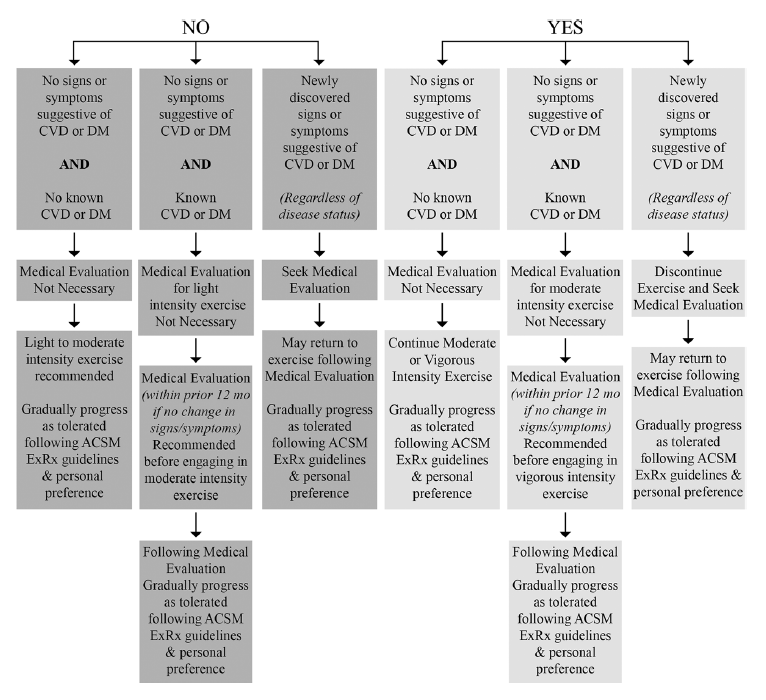
An individual's risk of experiencing an adverse event during exercise is now best determined using the updated 2025 ACSM Exercise Preparticipation Health Screening Algorithm. This version reflects current evidence that signs and symptoms of disease--not merely the presence of a diagnosis--are the most critical indicators for requiring medical clearance. It also supports safe self-initiation of exercise for most asymptomatic individuals, even those with stable chronic disease, particularly when beginning at light to moderate intensity.

Initial Consultation Workflow

  1. 1PAR-Q+
  2. 2ACSM screening algorithm
  3. 3Supplemental intake
  4. 4Goals, lifestyle, and autonomy
  5. 5Program design

The primary considerations are:

  • Current Physical Activity Level
  • Known Diagnosed Cardiovascular or Metabolic Disease
  • Presence of Signs or Symptoms Suggestive of Disease

Key Screening Recommendations Based on the New Algorithm

Key Screening Recommendations Based on the New Algorithm

Client TypeSigns or Symptoms Present?Medical Clearance Needed?Exercise Guidelines
Currently InactiveNoNoBegin with light-to-moderate intensity exercise and progress gradually.
Currently InactiveYesYesMedical clearance required prior to any exercise.
Currently ActiveNoNoContinue moderate or vigorous intensity exercise as appropriate.
Currently ActiveYesYesDiscontinue exercise and seek medical clearance before resuming at any intensity.
Diagnosed Disease but AsymptomaticNoNot necessarilyMay begin or continue light-to-moderate exercise; clearance recommended for vigorous.

Signs and Symptoms to Screen For:

  • Chest discomfort with exertion
  • Unexplained shortness of breath at rest or with mild exertion
  • Dizziness or syncope
  • Ankle edema
  • Palpitations or irregular heartbeat
  • Intermittent claudication (cramping in legs with activity)
  • Known heart murmur
  • Unusual fatigue or shortness of breath with usual activities

If any signs or symptoms are present, stop the screening and refer the individual for medical clearance prior to engaging in or resuming an exercise program.

Stop screening and refer

Chapter 3 signs and symptoms list

If any of these signs or symptoms are present, stop the screening and refer the individual for medical clearance prior to engaging in or resuming an exercise program.

  • Chest discomfort with exertion
  • Unexplained shortness of breath at rest or with mild exertion
  • Dizziness or syncope
  • Ankle edema
  • Palpitations or irregular heartbeat
  • Intermittent claudication
  • Known heart murmur
  • Unusual fatigue or shortness of breath with usual activities

Revised Screening Steps for Fitness Professionals:

  • Determine whether the individual currently engages in regular physical activity (i.e., 30+ minutes of moderate-intensity exercise on >=3 days/week for at least 3 months).
  • Identify any known cardiovascular or metabolic disease (e.g., heart disease, diabetes, or obesity).
  • Screen for current signs or symptoms suggestive of such diseases.

Updated Guidance on Medical Clearance:

  • Clearance is generally not needed for asymptomatic individuals starting at light-to-moderate intensities, even with stable chronic conditions.
  • Medical clearance is required if signs or symptoms are present, regardless of activity status.
  • Individuals desiring to begin or progress to vigorous intensity may benefit from medical clearance depending on their disease status, age, and clinician's judgment.

This simplified and evidence-aligned screening method supports the goal of reducing barriers to physical activity while maintaining safety and prudent clinical oversight. Fitness professionals should document findings and, when in doubt, defer to medical providers for clearance and collaboration.

Updated ACSM 2025 Exercise Participation Screening Algorithm
Figure 3.2: Updated ACSM Exercise Participation Screening Algorithm.

Screening documentation

Exercise preparticipation questionnaire

Table 3.2: Exercise Pre-participation Health Screening Questionnaire for Exercise Professionals

Exercise Pre-participation Health Screening Questionnaire for Exercise Professionals

StepScreening contentAction
Step 1: SymptomsAssess your client health needs by marking all true statements: chest discomfort with exertion; unreasonable breathlessness; dizziness, fainting, blackouts; ankle swelling; unpleasant awareness of a forceful, rapid, or irregular heart rate; burning or cramping sensations in your lower legs when walking short distance.If you did mark any of the statements under the symptoms, STOP, your client should seek medical clearance before engaging in or resuming exercise. Your client may need to use a facility with a qualified medical staff. If you did not mark any symptoms, continue to steps 2 and 3.
Step 2: Current ActivityDoes your client currently perform planned, structured, physical activity at least 30 minutes at moderate intensity or at least 3 days per week or at least 3 months? Yes / No.Continue to step 3.
Step 3: Medical ConditionsHas your client had or do they currently have: a heart attack; heart surgery, cardiac catheterization, or coronary angioplasty; pacemaker/implantable cardiac defibrillator/rhythm disturbance; heart valve disease; heart failure; heart transplantation; congenital heart disease; diabetes; renal disease.Evaluate steps 2 and 3.
Evaluating steps 2 and 3If you did not mark any of the statements in Step 3, medical clearance is not necessary. If you marked Step 2 yes and marked any of the statements in Step 3, your client may continue to exercise at light to moderate intensity without medical clearance.Medical clearance recommended before engaging in vigorous exercise. If you marked Step 2 no and marked any of the statements in Step 3, medical clearance is recommended. Your client may need to use a facility with a medically qualified staff.

Screening step three

Supplemental intake, exercise history, and prior experiences

Step Three of the Screening Process

Create an Additional Intake Form

To further inform the discussion during the initial consultation, the fitness professional should consider creating an additional intake form, diving deeper into exercise history, apprehensions, goals, and lifestyle. The information below will help guide the creation of this intake form.

Expanding on Their Exercise History

  • Are they currently exercising?
  • Can they currently walk briskly several miles without fatigue (this will give a general idea of aerobic capacity and conditioning)?
  • Briefly describe current or past aerobic exercise program (this will give an idea of conditioning, the efficiency/effectiveness of the program, and whether they need to learn how to improve their program).
  • Briefly describe current or past strength training program (this will also give an idea of strength conditioning, the efficiency/effectiveness of the program, and whether they need to learn how to improve their program).

History with Other Fitness Professionals

Have they worked with fitness professionals in the past? If so, how recently?

What did they like about previous experiences? What did they dislike? This information will help to understand their mindset. The trainer can piggyback off what they liked and avoid what they disliked.

Client context

Goals, SMART goals, and lifestyle factors

Goals

Individual goals are typically related to aerobic, strength, flexibility/mobility, balance, weight loss, activities of daily living, and/or general health. Athletes generally have specific performance, strength, hypertrophy, or body weight-related goals.

The acronym, S.M.A.R.T. is commonly used to help fitness professionals or exercisers establish goal setting, where "S" stands for Specific, "M" stands for Measurable, "A" stands for Achievable, "R" stands for Relevant, and "T" stands for Time-bound. The following is a common example:

S.M.A.R.T. Goals

SMART Goals

S

Specific

What do you want the program to accomplish?

M

Measurable

How do we measure the goals?

A

Achievable

Do they have the skills and resources/support to achieve their goals?

R

Relevant / Realistic

Why is it important?

T

Time-bound

Short, medium, and long-term goals.

Specific: What do you want the program to accomplish?

e.g., lose weight, "tone up," feel better, reduce pain and medications.

Measurable: How do we measure the goals?

Objective (e.g., training logs, improvements in health, body composition, weight).

Subjective (e.g., improve activities of daily living, confidence).

Achievable: do they have the skills and resources/support to achieve their goals?

Fitness professional can assist with skill improvement and as a resource to help achieve goals.

A social network is helpful as well (e.g., family, friends, co-workers).

Relevant and Realistic: why is it important?

e.g., improved health, performance, an upcoming event.

Time-bound: short, medium, and long-term goals.

e.g., phases within a Periodized program, weight loss.

Helpful questions which can be asked in addition to the S.M.A.R.T. goals include:

  • Was there a time in your past when you were happy with your __________ (fitness, weight, health, etc.)?
  • For how long?
  • What kept you going?
  • Did you have social support? How important is social support? Do you have social support now?
  • What caused you to slow down or stop?
  • How can we overcome those barriers?
  • What are the reasons you're ready to begin again now?

Overall lifestyle

Learn from the potential client about their job, life stressors, sleep habits, eating habits, relationships, hobbies, and other activities to obtain an overall picture about their habits. Being cognizant of their stress levels and outside demands are important considerations in managing their overall workload.

Adherence and trust

Autonomy in program design

Inquire About Autonomy

Ask the potential client what they would like emphasized or avoided in their program design. It is important to identify any apprehensions, such as performing a certain exercise or movement, or determine if there is anything else they'd like the fitness professional to know. Providing the client autonomy has been shown to increase trust and adherence (Halperin, 2018). Even if the fitness professional disagrees (which they should keep to themselves), they should always ask and, at least initially, incorporate into the program the client's suggestions.

Summary and application

Practical application of the initial consultation

Summary

This chapter has outlined a comprehensive framework for the initial consultation and screening process, emphasizing the importance of establishing a strong foundation for exercise program design. The Physical Activity Readiness Questionnaire (PAR-Q+) and supplemental intake forms serve as critical tools to assess a client's health, fitness level, and readiness for exercise. These tools ensure that fitness professionals are equipped to identify potential risks and tailor programs that align with the client's needs, goals, and preferences.

By integrating strategies such as the ACSM's Preparticipation Health Screening Recommendations and leveraging detailed intake forms, the screening process enables fitness professionals to gain insights into a client's history, lifestyle, and aspirations. This personalized approach helps create trust, enhances adherence, and lays the groundwork for a safe and effective exercise regimen.

Ultimately, this chapter highlights the value of combining standardized protocols with individualized attention. Doing so ensures that clients of varying fitness levels and medical histories can embark on a journey toward improved health and well-being with confidence and support.

Practical Application

Implementing the concepts from this chapter in real-world settings involves more than understanding the protocols--it requires applying them with precision and empathy. Fitness professionals should strive to create a client-centered experience during the initial consultation and screening. Key steps to apply these principles include:

  • Conduct Thorough Initial Assessments: Begin each client relationship by using the PAR-Q+ and the expanded intake forms. These tools provide essential data on medical history, exercise experience, and personal goals. Tailor your approach based on the client's unique profile.
  • Focus on Communication and Education: Take time to explain the screening process and how it informs their fitness journey. Address any apprehensions clients may have and offer reassurance about how the program will adapt to their needs.
  • Personalize Program Design: Use the information gathered to design a program that aligns with the client's abilities and objectives. For instance, if a client expresses a preference for certain exercises or goals, incorporate those elements early to build engagement and trust.
  • Monitor and Adjust Regularly: A screening process is not a one-time event. As clients progress, reassess their fitness levels, goals, and barriers to ensure the program remains effective and motivating.
  • Build Rapport through Autonomy: Actively involve clients in the decision-making process for their fitness plans. Providing autonomy fosters a sense of ownership and encourages adherence.

By integrating these practical strategies, fitness professionals can transform the theoretical frameworks of this chapter into actionable steps that enhance the quality and outcomes of their practice.

These steps ensure that the initial consultation aligns with the iterative nature of the universal algorithm, creating a seamless transition from assessment to program implementation and eventual progression.

Initial Consultation to Safe Starting Plan

  1. 1Use PAR-Q+ and expanded intake forms
  2. 2Explain the screening process
  3. 3Personalize from abilities, goals, history, and preferences
  4. 4Monitor and adjust regularly
  5. 5Build rapport through autonomy

Video / media support

Initial Consultation and Screen

Watch this stand-alone lesson after the embedded chapter reading. Use it to reinforce the consultation flow, ACSM screening logic, documentation, client communication, and safe next-step decisions.

8 min 51 sec

Watch the Module 3 video to reinforce the initial consultation and screening process.

Watch video

Interactive recall

Screening decision points

Use these cards to reinforce the safety and referral distinctions that appear throughout the chapter.

Interactive recall

Intake, goals, and adherence

Use these cards to connect the screening tools to the relationship-building side of the initial consultation.

Applied case study

Applied scenario: first consultation and screening pathway

A new client is inactive and wants to begin exercise after years away. They report a prior diagnosis of type 2 diabetes, no current chest discomfort, dizziness, palpitations, unusual breathlessness, or other signs/symptoms, and a goal to improve strength, confidence, and energy. They also say previous gym experiences felt intimidating and they want to avoid exercises that make them feel embarrassed.

How should the screening pathway be interpreted before exercise begins?

Start with symptoms. Because no signs or symptoms are reported, continue to activity status and known disease. The client is inactive with known metabolic disease, so the starting plan should be conservative and medical clearance may be recommended, especially before vigorous exercise or if uncertainty emerges.

What supplemental intake information would change the first programming decision?

Clarify current activity, medications or medical guidance if disclosed, blood pressure/glucose monitoring context if relevant, exercise history, confidence, barriers, prior negative experiences, goals, sleep, stress, schedule, and preferred or avoided exercises.

How can the first plan reduce barriers while preserving safety?

Use light-to-moderate intensity, simple exercises, privacy and confidence-building choices, clear monitoring, and SMART goals. Include the client's preferences when safe so autonomy supports trust and adherence.

What would require pausing or referring?

New signs or symptoms, unclear restrictions, concerning blood pressure or health information, desire for vigorous intensity without appropriate clearance, or any question outside fitness scope should prompt medical communication or referral.

This scenario practices chapter-based screening and programming reasoning only. It does not diagnose, treat, clear, prescribe medical care, persist quiz results, or create official assessment records.

Knowledge check

Module 3 10-question local quiz

10-question quiz

Answered: 0/10

Current score: 0/10

Submit to review your score and feedback.

Public preview mode: quiz interaction stays on this device and is not saved.

1. What is the primary purpose of screening in Chapter 3?

2. Which statement best distinguishes screening from assessment?

3. True or false: In the Universal Algorithm sequence, screening sets the safety context before assessment, initiation, progression, or regression.

4. What does the PAR-Q+ contribute to the initial consultation?

5. Under the updated ACSM screening logic, what should happen when signs or symptoms suggestive of cardiovascular or metabolic disease are present?

6. True or false: An inactive client with no signs/symptoms and no known cardiovascular or metabolic disease may generally begin light-to-moderate exercise and progress gradually.

7. What is the chapter's definition of being currently active for screening purposes?

8. True or false: Chapter 3 recommends a supplemental intake form because PAR-Q+ does not capture all exercise history, goals, apprehensions, lifestyle, and preference information.

9. What does the SMART goal framework stand for in the chapter?

10. Why does the chapter emphasize autonomy during intake?

Answer all questions, then submit to display the final score.

A score of 7/10 or higher is required for saved module completion.

Submit the quiz to see your score and review feedback.

Supplementary resources

Full PAR-Q+

Access the complete PAR-Q+ screening questionnaire.

Access Full PAR-Q+

Professional reflection

Think of a client who is eager to start quickly. How would you explain the value of screening, gather supplemental intake information, preserve autonomy, and still decide whether to proceed, modify, or refer?

Use this reflection to prepare your professional reasoning before moving on.

Takeaways and next step

Screening and assessment are related but distinct professional tasks.

The updated screening pathway centers current signs and symptoms, activity status, and known cardiovascular or metabolic disease.

PAR-Q+ starts the safety screen; supplemental intake completes the coaching context.

SMART goals, lifestyle context, prior experiences, and autonomy make the first program more usable and more likely to be sustained.

Module 3 integrates the full chapter reading with video, practice, and quiz reinforcement.

Use this chapter pattern as the model for later modules: read the structured source sections, review visual briefs and media, practice with the case, complete the local quiz, then carry the screening logic into Module 4 exercise prescription and progression.