Full chapter reading
Chapter 1: Fundamental Principles in Exercise Prescription
Chapter 1
Fundamental Principles in Exercise Prescription
Introduction
This chapter lays the foundation for understanding exercise program design through essential principles that govern safe, effective, and individualized training. From Seyle's General Adaptation Syndrome to the principles of specificity and progressive overload, these concepts are critical for creating adaptable and sustainable exercise plans. Fitness professionals will see how these principles resonate across all chapters, forming the cornerstone of the universal algorithm.
Principles and Guidelines
Seyle's General Adaptation Syndrome (GAS)
A foundational concept in exercise science, GAS explains how the human body responds to stressors, including physical exercise. Understanding this model is crucial because it underpins how exercise programs are structured to optimize adaptation, prevent plateaus, and balance recovery. Any organism, such as the human body, goes through three stages when presented with a stress. Exercise is a stress to the body - a good stress with proper program design. The three stages are (Figure 1.1):
Figure 1.1: Seyle's General Adaptation Syndrome.
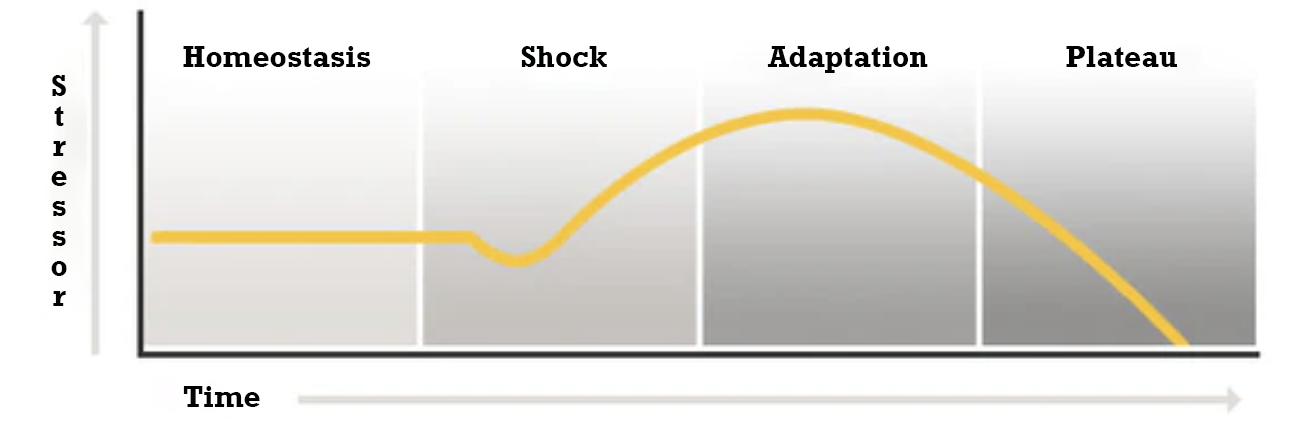
1. Shock - This is the first stage the body goes through. It can last from two weeks to several months. In this stage, exercise training, whether it is the initial start-up or a change in routine, is a stress to the body that is threatening its integrity and disrupting the body's homeostasis (balance). The greater an individual's fitness level, the faster they can adapt to stressors and the less time they will spend in this phase.
With appropriate frequency, the body will begin to recognize the stress and adapt to it. In this stage, fitness level, or performance, usually decreases slightly (Figure 1.1). This is where most of the delayed onset muscle soreness (DOMS) is felt. That soreness (which typically lasts 1-3 days) will decrease and may eventually disappear as they enter stage two.
2. Adaptation - This stage also lasts approximately two weeks to several months. During this phase, the body undergoes physiological changes such as increased muscle strength and greater resistance to fatigue. These adaptations are the result of consistent exposure to the training stimulus and adequate recovery. The body is now recognizing the stress - it is no longer a shock to the system. In this stage fitness level and performance are increasing and health is most likely improving. Again, the greater an individual's fitness level, the less time spent in this phase because their fitness level allows for faster adaptation to stressors.
3. Plateau - Once the body has adapted to a stress or stressors there is nothing left to adapt to. It will reach a plateau and eventually exercise will begin to get stale both mentally and physically. Mental staleness often manifests as a lack of motivation, reduced enthusiasm for workouts, and feelings of boredom or frustration with repetitive routines. This can significantly impact adherence to an exercise program, as individuals may be less inclined to push themselves or remain consistent. Addressing both physical and mental staleness is essential to sustain long-term engagement and progress. A change on the stress applied to the body is needed so that it can briefly go through Stage 1 again, followed by Stage 2. (Cunanan, 2018; Turner, 2011)
Why is this Important?
The concept of Periodization, which will be discussed later, was founded on Seyle's General Adaptation Syndrome. An efficient and effective program should be designed to place enough stress on the body to cause adaptations to occur, but not so much that soreness is excessive, and performance significantly decreases.
Many people mistakenly believe that soreness indicates a good workout. However, delayed onset muscle soreness (DOMS) usually results from unfamiliar exercises, increased volume, or higher intensity-not necessarily from workout quality. Chasing soreness can lead to overtraining or poor program design. Instead, progress should be measured by improvements in strength, conditioning, and overall performance. Fitness and performance gains over time-not soreness-are the true markers of an effective program. Since soreness typically decreases during the Adaptation stage (Stage 2), it's important to understand its role in the continuum of stress adaptation.
Understanding of GAS is also important because it takes time for the body to adapt to a stress. Therefore, an efficient program will introduce a stress, such as a new exercise variation or an increase in volume or intensity and then allow the body some time to adapt to it before changing the stress. Variety is important, but too much variety, too often, may not allow the body enough time to adapt and may lead to a less effective program.
Additionally, the concept of GAS is important to understand because if a plateau in fitness or performance occurs, it is usually a sign that the body has adapted to the stress or stressors placed upon it. At this point, practical adjustments-such as adjusting exercise intensity, changing the type of exercise, or altering volume-can reintroduce a new stimulus, prompting further adaptations. Fitness professionals and exercisers can use working knowledge of GAS to develop programs that include enough variety to avoid plateaus, while avoiding excessive variety which can lead to reduced performance gains over time.
Principle of Specificity
Another important fundamental in exercise science, specificity emphasizes that training adaptations are directly related to the type of exercise performed. The American College of Sports Medicine's (ACSM) definition is as follows:
"The observation that fitness/performance improves through training movement patterns and intensities of a specific task and fitness type (strength, power, endurance, or flexibility)." The specific physiological adaptations to resistance training are determined by various factors, including:
The muscle actions involved (i.e., isometric, concentric, eccentric).
Speed of movement.
Range of motion.
Muscle groups trained.
Energy systems involved (i.e., phosphagen, glycolytic, aerobic).
Intensity and volume of training. (Garber, 2011)
The National Strength and Conditioning Association (NSCA) adds, "The body adapts to exercise in such a way that it can perform optimally in relation to that particular type of exercise stressor, but not necessarily other types of exercise. (Coburn, 2018). For example, chronic endurance training without resistance training will not improve strength. Similarly, training exclusively with light weights at high velocities won't significantly enhance maximum strength."
While the Principle of Specificity highlights the importance of targeted stressors for specific adaptations, Seyle's General Adaptation Syndrome (GAS) demonstrates that the body also adapts in a more generalized fashion to repeated stress. These two concepts are not contradictory but complementary-specific stressors drive targeted outcomes, while the general adaptation process ensures the body can respond to a range of stressors effectively.
Why is this Important?
While applying specific stimuli to the body are important to induce adaptations that will lead to meeting or exceeding the individual's needs and goals, it is also important to understand that a person can improve in an exercise and in their overall fitness through a general increase in strength, conditioning, and power. In other words, adaptations lie on a continuum and often there is a carryover effect (i.e., transfer of training adaptations).
The ACSM goes on to say, "Although there is some carryover of training effects to other general fitness and performance attributes, the most effective resistance training programs are those that are designed to target specific training goals." (Garber, 2011)
Note that the definition includes, "...although there is some carryover of training effects to other general fitness and performance attributes..."
This carryover lies on the continuum mentioned above, many times defined by an individual's fitness level. (Brearley, 2019; Schoenfeld B., 2018) For example, an individual with a beginner level of strength fitness can improve performance in the squat exercise by increasing general strength through other exercises, such as a leg press. As their strength fitness improves, it becomes increasingly important to apply the Principle of Specificity - in this case, training the movement pattern (i.e., squat) itself.
Using another example, a deconditioned individual could improve their aerobic capacity and economy (ease) of running through strength training alone. Strength training enhances aerobic capacity by increasing muscular efficiency, improving oxygen utilization, and reducing energy expenditure during movement. When performed across a spectrum of repetition ranges, strength training can build both strength and local muscular endurance, indirectly supporting aerobic performance. But at some point, they would need to include aerobic exercise, and more specifically, running to continue to see improvements in both aerobic capacity and running economy.
This principle addresses the misconception that training should focus exclusively on movements rather than muscles, or that loading a movement is the only way to improve 'functional' strength. In reality, both approaches are important and context-dependent, with general strength and conditioning often providing significant carryover to functional movements, especially for beginners and intermediates. It is dependent upon where the individual lies on a continuum of fitness. Since most of the general population falls within the beginner to intermediate domains of fitness, there will be significant carryover. Increasing overall strength and conditioning will increase functional capacity. Conversely, many times loading a "functional movement" requires reducing loads, especially when the movement involves more than one plane of motion (e.g., lunge with a torso rotation) or small muscle groups. This reduces strength potential and can ultimately defeat the purpose.
Principle of Overload
The training stress should slightly exceed either what an individual is normally accustomed to doing, and/or should exceed the training stress of a previous work out. Otherwise, there is nothing for the body to adapt to. In resistance training, overload is typically accomplished by increasing the sets per exercise or muscle group; varying repetitions within a set and the corresponding load that is being used; and/or decreasing rest periods in-between sets. In aerobic and flexibility training overload is accomplished by increasing frequency, duration, intensity, or by changing from one mode to another. (Kasper, 2019; Sands, 2012)
Principle of Progression
Building on the Principle of Overload, Progression refers to the gradual and systematic increase of training demands over time to continue stimulating adaptation. While Overload focuses on surpassing current stress levels, Progression emphasizes how these increases are applied in a structured and sustainable way. Together, they form the concept of Progressive Overload. This refers to modifying exercise program over time, by progressing in frequency (e.g. from 3 to 4 days per week); volume (e.g. from 2 sets per muscle group to 3 sets per muscle group, or increasing duration of aerobic training); intensity (e.g. from terminating a set in resistance training knowing four more repetitions could have been performed, to terminating a set knowing only two more repetitions could have been performed [i.e. closer proximity to muscle failure], or running at a faster pace); or from a simple movement to a more complex one. (Kasper, 2019; Sands, 2012)
Why are These Principles Important?
Humans are creatures of habit, especially with their exercise routines. Many exercisers perform the same routine day after day, week after week, month after month. Lack of progression and overload will also lead to staleness and plateau. Fitness gains and improvement will stall, and this can lead to lack of motivation and eventually disinterest.
The individual should understand that progression, such as a continual increase in strength over time in primary movements like squats and deadlifts, is generally a more effective approach than frequently introducing trendy or superficial exercises. Focusing on measurable strength and conditioning improvements-often reflected in setting personal records-provides consistency, fosters long-term motivation, and enhances adherence to an exercise program. Regularly achieving personal records in primary exercises is not only fun but also gives a strong sense of accomplishment and reinforces the habit of training. Each personal record represents progress, creating a 'new you'-one that is stronger, more conditioned, and healthier than before.
Principle of Initial Values
This principle states that those with the lowest initial values of a physiologic system have the greatest capacity for improvement in response to training. In practical terms, this means beginners or deconditioned individuals are likely to see rapid progress with almost any structured program, whereas more advanced individuals require increasingly specific and targeted interventions to continue improving. This principle helps guide program design by setting realistic expectations based on an individual's starting point.
Why is this Important?
It may seem obvious that weaker or deconditioned individuals have the greatest capacity for improvement. In practice, this means that beginners often see progress with almost any program, even those that are suboptimal or poorly designed. However, these initial gains are typically short-lived without a structured and purposeful approach. This can create a false view that a program is "good" because it initially produces results. Signs of an ineffective program might include lack of clear progression strategies, reliance on random exercises without purpose, excessive soreness after every session, or failure to address long-term goals. These red flags often indicate a lack of structure and alignment with foundational exercise principles. Many programs lack structure and fail to adhere to the principles of exercise, yet people will see results. The problem is that plateaus will occur more quickly, staleness and boredom will set in, and eventually the person will quit because they are no longer seeing progress. Proper program design adheres to and revolves around the principles of exercise from the start, which leads to ongoing increases in fitness and increases the probability of creating a lifelong exerciser.
Henneman's Size Principle
This fundamental principle is central to understanding strength training, as it determines how motor units are recruited to produce force and drive muscle adaptation. This concept governs motor unit recruitment and states that increasing a muscle's force production and/or size (hypertrophy) requires the recruitment of an increasing number of motor units. Higher loads, proximity to muscle failure, and neuromuscular fatigue are the primary drivers of this recruitment process. Lower amounts of force (i.e., lighter loads) require fewer motor units unless the set is taken to or very close to muscle failure. In contrast, higher amounts of force (i.e., heavier loads) demand more motor unit recruitment, with most motor units being activated either at the start of the set or shortly after it begins. The 'sum of motor unit recruitment' refers to the total number of motor units actively engaged throughout the set, which varies based on load and proximity to failure (De Luca, 2015; Kraemer, 2012).
In controlled movements (such as in most resistance training exercises and during activities of daily living) motor units (hereafter referred to as muscle fibers) are recruited in order of size (thus, the Size Principle). As stated above, the primary mechanisms which determine muscle fiber recruitment are the load (weight), proximity to muscle failure, and neuromuscular fatigue.
There are two categories of muscle fibers: endurance and strength (De Luca, 2015). Strength muscle fibers are further divided into multiple sub-categories, with the primary focus here being on Type IIa (medium-sized) and Type IIx (large) fibers. These two sub-categories are emphasized because they play a critical role in high-force production, power output, and hypertrophy, making them particularly relevant for resistance training and overall performance. Endurance (Type I) muscle fibers are smaller than strength muscle fibers.
In general, most activities of daily living don't require much force, so strength muscle fibers have no need to be recruited and are, therefore, never trained. However, during resistance training, assuming sets are taken to at or within a few repetitions of muscle failure, strength muscle fibers are recruited which will lead to increases in strength, lean muscle tissue, or both. The difference, shown in Table 1:1, relates primarily to the load being lifted, proximity to muscle failure, duration of the set (heavier weights = shorter duration, lighter weights = longer duration), volume-load, and level of fatigue.
To optimize increases in strength and hypertrophy, individuals should focus on training within the 5 to 15 repetition range. While heavier loads (1-8 reps) prioritize strength gains, moderate loads (8-15 reps) balance strength and hypertrophy adaptations. Training Above 15 repetitions can still induce hypertrophy but contributes minimally to strength development.
Table 1:1: Henneman's Size Principle of Strength and Hypertrophy
Motor Unit Recruitment Continuum
Henneman's Size Principle describes a recruitment pattern: as force demand, load, fatigue, and proximity to failure increase, recruitment expands from smaller lower-threshold motor units toward larger high-force motor units.
Low force / low load
Type I motor units are recruited first because they are smaller, lower-threshold, and fatigue resistant.
- Common during daily activity and lower-force exercise.
- Fewer strength fibers are needed unless the set approaches failure.
Moderate force / moderate load
Type IIa motor units become increasingly involved as force demand and fatigue rise.
- Useful range for balancing strength and hypertrophy adaptation.
- More strength fibers are recruited as the set moves closer to failure.
High force / heavy load or high fatigue
Type IIx and other high-force motor units are recruited when load is heavy or fatigue/proximity to failure is high.
- Heavy loads recruit many high-force fibers early in the set.
- Lighter loads require closer proximity to failure to recruit high-force fibers.
Table 1:1: Henneman's Size Principle of Strength and Hypertrophy
Strength
Strength adaptations are more load dependent and require moderate to heavy loading to drive continued strength progression.
- Proximity to muscle failure: working sets must be taken to within 0 to 3 repetitions of muscle failure for adaptations to occur.
- Load/repetition range: 1 to 15RM; heavier loads near 1RM create the strongest strength stimulus.
- Mechanism: moderate to heavy loads recruit type II strength fibers earlier, increase neural drive, and support rate of force development.
- Role of volume: volume is less important than load and neural drive; excessive set-volume may reduce strength development through accumulated fatigue.
Hypertrophy
Hypertrophy adaptations are less load dependent and can occur across a broader repetition continuum when sets are close enough to failure.
- Proximity to muscle failure: working sets must be taken to within 0 to 3 repetitions of muscle failure for adaptations to occur.
- Load/repetition range: 5 to 40RM, with 5 to 15 repetitions emphasized as the optimal range for hypertrophy.
- Mechanism: type II fiber recruitment, time under tension, metabolic stress, and volume-load support lean muscle tissue development.
- Role of volume: volume is more important for hypertrophy because accumulating fatigue, metabolic stress, and overall load-volume are major drivers.
Henneman's Size Principle Related to Strength
| 1 to 8 RM | 8 to 15 RM | 15+ RM |
|---|---|---|
| Most Strength Gains | Moderate Strength Gains | Little to No Strength Gains |
| Most Strength Fibers Recruited at Start of Set | Most Strength Fibers Not Recruited Until Later in Set | Most Strength Fibers Not Recruited Until End of Set |
Henneman's Size Principle Related to Hypertrophy
| 1 to 5 RM | 5 to 15 RM | 15 to 40 RM |
|---|---|---|
| Little to No Hypertrophy Gains | Optimal Hypertrophy Gains | Hypertrophy Gains but Little to No Strength Gains |
| Overall Volume and Metabolic Stress Are Low | Optimal Mix of Mechanical, Metabolic, And Volume-Load Stress | Mechanical Stress and Neural Drive are Low |
Why is this Important?
Henneman's Size Principle illustrates the need to train across a spectrum of repetition ranges to train the entire muscle. This includes training with moderate (i.e., the 8 to 12 repetition range), and heavy (i.e., the 4 to 8 repetition range) weights. Understanding when, why, and how to manipulate loads are critically important to effective exercise program design. For example, increasing loads progressively over time enhances strength development, while varying loads within a training cycle (e.g., alternating heavy, moderate, and light sessions) can optimize hypertrophy, conditioning, and recovery in addition to strength. Effective load manipulation ensures the right balance between stress and recovery, maximizing long-term progress.
Increasing strength through moderate to heavy loads effectively trains the entire muscle, increases lean muscle tissue, strengthens the skeleton, and reinforces connective tissue such as ligaments and tendons. It also activates and trains a larger fraction of the nervous system, supporting musculoskeletal, nervous, and metabolic health. These adaptations play a key role in preventing, managing, and controlling orthopedic issues and chronic diseases.
In contrast, training predominantly with light weights (e.g., 12+ repetitions per set) or stopping sets far from muscle failure recruits fewer motor units, limiting strength development and lean muscle growth. As a result, individuals miss out on many of the critical benefits resistance training offers.
Fitness-Fatigue Theory
The Fitness-Fatigue Theory explains the relationship between training stress, fitness gains, and fatigue accumulation. Every properly dosed training session creates both fitness improvements and fatigue. Fitness represents the positive adaptations resulting from exercise, while fatigue represents temporary reductions in performance capacity.
Key principles of the Fitness-Fatigue Theory include:
Training Stress: Higher stress leads to greater fitness improvements but also increased fatigue.
Recovery Time: Adequate recovery is required for fatigue to dissipate and for fitness adaptations to manifest.
Performance Fluctuations: Performance may temporarily decrease due to accumulated fatigue but will rebound and improve after sufficient recovery.
This theory reinforces the importance of fatigue as a driver of adaptation, but it also highlights the need for balance. While fatigue is necessary to elicit changes in fitness and performance, excessive fatigue without adequate recovery can lead to stagnation, overtraining, and regression.
Fitness-Fatigue Theory: Stress, Recovery, Performance
Training stress
A properly dosed session creates both a fitness stimulus and fatigue. More stress can create more adaptation, but it also increases the recovery demand.
Temporary performance dip
Accumulated fatigue may temporarily reduce performance even while the fitness adaptation is developing.
Recovery and rebound
With adequate recovery, fatigue dissipates and performance can improve. Without recovery, fatigue can overshadow fitness and lead to stagnation or regression.
Why is this Important?
Understanding the Fitness-Fatigue Theory helps fitness professionals and exercisers balance training intensity, volume, and recovery. Without sufficient recovery, accumulated fatigue can overshadow fitness gains, leading to overtraining, performance stagnation, or regression. By strategically planning stress and recovery cycles, fitness professionals can optimize long-term progress and ensure consistent improvements in strength, hypertrophy, and conditioning.
Table 1:2: Fitness-Fatigue Theory Overview
Table 1:2: Fitness-Fatigue Theory Overview
| Training Stress(i.e., Dose) | Fitness Adaptation | Fatigue Accumulation | Recovery Time | Performance Impact |
|---|---|---|---|---|
| Low | Minimal | Minimal | Short | Slight Increase |
| Moderate | Significant | Moderate | Moderate | Delayed Increase |
| High | Large | High | Long | Temporary Decrease |
When viewed alongside Henneman's Size Principle, the Fitness-Fatigue Theory underscores the importance of training to a point where fatigue is sufficient to drive adaptation without pushing into excessive fatigue that undermines recovery. Together, these two principles create a roadmap for effective resistance training-balancing load, proximity to failure, volume, and adequate recovery to drive sustainable adaptations.
Principle of Individualization
This principle describes the modification of training to account for an individual's unique capacity for and response to training. Training programs should be individualized based on age, current level of fitness, exercise history, and levels of motivation and confidence, along with their overall lifestyle, health, and nutrition habits. (Kasper, 2019) (Sands, 2012)
Why is this Important?
No matter how well a program is designed, it will not be effective if the individual cannot perform it. Every person begins with a unique foundation shaped by their fitness level, exercise history, lifestyle, and physical limitations. While modifications are essential to tailor an exercise program to an individual's needs, it's important to note that there are far more similarities than differences in program design across individuals, as described in Chapters 4 and 6.
The primary differences in individualized program design lie in the selection of initial loads, rate of progression, choice of exercises, and available range of motion. These factors ensure that programs remain both accessible and effective, aligning with each individual's capacity for progress.
Principle of Reversibility
This principle describes the observation that withdrawal of tissue loading (i.e., inadequate training or the cessation/stoppage of training) results in a loss of beneficial fitness and performance adaptations. The body adapts to inactivity or insufficient training load with losses in lean muscle, strength, power, endurance, and overall fitness. (Kasper, 2019; Sands, 2012)
Reversibility occurs at different rates depending on the fitness component. Endurance adaptations, such as cardiovascular efficiency, tend to decline more quickly (within 1-2 weeks of inactivity), while strength and muscle mass are more resilient, with noticeable declines occurring after 3-4 weeks of reduced training.
Why is this Important?
Within the scope of a year, it is extremely important to schedule periods of complete rest, active rest, recuperation, and/or deload periods. These planned breaks allow the body and mind to recover while preventing overtraining and mental burnout. However, extended periods of inactivity can reverse fitness gains, highlighting the importance of balancing rest with consistent training stimuli to sustain long-term progress.
Principle of Accommodation
Quoting directly from The Science and Practice of Periodization: A Brief Review (Turner A., 2011), "Monotonous volume loads and training methods can predispose an athlete to accommodation and stagnation." This principle, as outlined by Zatsiorsky and Kraemer, highlights that the human body adapts to repeated stimuli, eventually reducing the effectiveness of unchanging training programs. Without variation, neural and muscular systems adapt fully, leading to stagnation.
Accommodation occurs because neural adaptations-such as motor unit recruitment, rate coding, and synchronization-plateau when the same stimulus is applied repeatedly. This stagnation underscores the importance of variability within periodized strength and conditioning plans. Variation can include changes to volume (sets and repetitions), intensity (load), frequency, rest periods, and exercise selection. These adjustments ensure the body is continually challenged to adapt, preventing mental and physical plateaus while optimizing performance improvements.
Law of Diminishing Returns
The law of diminishing returns complements the principle of accommodation, emphasizing the slowing rate of progress as an athlete becomes more advanced. Beginners experience rapid gains due to the novelty of training stimuli, while seasoned trainees require increasingly precise and targeted interventions to achieve incremental improvements. Accommodation can occur at any stage of training, but diminishing returns are most noticeable in advanced athletes nearing their genetic or physical potential.
The diminishing returns principle also reflects the efficiency of effort: with advanced trainees, significant effort yields smaller improvements compared to the same effort in a novice. This underscores the need for a structured and intentional approach to programming, focusing on variables like progressive overload, recovery, and periodization.
Accommodation, Diminishing Returns, and Strategic Variation
These concepts explain why a program should not stay unchanged forever, but also why variation should be purposeful rather than random.
Repeated unchanged stimulus
When the same stimulus is repeated too long, the body accommodates and the training effect decreases.
- Risk: stagnation, mental staleness, reduced adaptation.
- Professional action: monitor response and adjust variables before the program becomes stale.
Higher training status
As fitness improves, the rate of improvement slows and programming must become more precise.
- Beginners may improve rapidly from many structured programs.
- Advanced clients need more targeted overload, recovery, and periodization decisions.
Strategic variation
Purposeful variation changes the stimulus enough to prevent plateau while preserving the continuity needed for adaptation.
- Adjust volume, intensity, frequency, rest, tempo, or exercise selection.
- Avoid random novelty that prevents useful adaptation.
Principle of Variation: A Strategic Solution
Addressing both accommodation and diminishing returns requires strategic variation, which involves the intentional manipulation of training variables to sustain adaptation. The Principle of Variation emphasizes balancing novelty with consistency, ensuring that changes in training are purposeful rather than random. Effective programs primarily adjust key variables such as volume, intensity, and frequency, while also incorporating modifications to exercises, tempos, or rest periods as needed.
Being purposeful about "changing up" an exercise program provides novelty, increases engagement, and allows for adaptations to new training stimuli. For example, a runner might incorporate hill sprints or strength training into their routine to improve endurance and speed. Similarly, a lifter could rotate between squat variations to target different muscle groups while progressing volume and intensity. When done well, variation not only prevents boredom but also enhances overall performance and satisfaction.
Variation can involve incorporating new exercises or movements, but it often means making simple adjustments, such as changing the number of repetitions or sets, or modifying an existing exercise (e.g., transitioning from a backward lunge to a walking lunge). Small adjustments over time are invaluable for maintaining progress and avoiding stagnation.
However, excessive variation can hinder progress and lead to disengagement. One inefficient approach to program design, discussed further in Chapter 4, involves prioritizing numerous assistance exercises (e.g., bicep curls, chest flys, or lateral raises) at similar loads over compound, primary exercises. Instead, focusing on manipulating frequency, volume, intensity, and rest periods for a smaller set of foundational movements ensures that training is both efficient and impactful, targeting key adaptations while minimizing redundancy.
By balancing consistency with strategic variation, trainers and exercisers can optimize skill development, neural and muscular adaptation, and mental engagement, ensuring progress is both measurable and sustainable.
Balancing Consistency and Variability
Too much variability can reduce adaptation and impede progress, especially if changes occur before sufficient stress has been applied. On the other hand, excessive consistency risks stagnation and loss of motivation. Effective programming strikes a balance:
Consistency: Focus on foundational movements and gradual progression.
Variation: Introduce strategic changes to training variables to sustain interest and prevent plateaus.
For example, a runner might add hill sprints or strength training to improve endurance and speed. Similarly, a lifter could rotate between squat variations to target different muscle groups while progressing volume and intensity. This balance fosters skill development, neural and muscular adaptation, and mental engagement.
Why is This Important?
The principles of accommodation and diminishing returns highlight the risks of stagnation and slowed progress when training routines lack thoughtful variation. Neural and muscular adaptations plateau when the same exercises, loads, and rep schemes are applied repeatedly. Without addressing these challenges through structured variability, individuals risk hitting plateaus, reducing performance improvements, and losing motivation. Periodized training programs, grounded in these principles, provide the variability needed to continually challenge the body and ensure long-term success in reaching fitness goals.
Wolff's Law
This law states that bone adapts specifically to the load under which it is placed, as well as to the angle of stress. (Chen, 2010) This means that increasing the weight (i.e., progressive overload) is crucial in improving the strength and density of the skeleton. It also means that varying angles to stress each part of a joint or limb are important for balanced development and injury prevention.
In practical terms, weight-bearing exercises like squats, deadlifts, and plyometric movements stimulate bone density by applying consistent mechanical stress. Similarly, varying the angle of stress-such as performing incline versus flat bench presses-targets different regions of a joint or bone, reinforcing structural strength across multiple planes of movement. This principle highlights the importance of including both progressive overload and strategic angle variation in training programs to optimize skeletal health and resilience.
Davis' Law
Building upon Wolff's Law, which focuses on bone adaptation, Davis' Law states that muscle will adapt specifically to the load and angle of stress placed upon it. While Wolff's Law highlights skeletal remodeling under stress, Davis' Law explains how muscles, tendons, and soft tissues respond similarly by increasing strength, flexibility, and resilience when appropriately stressed (DiGirolamo, 2013; Nutt, 1915; Toigo, 2006).
For example, an incline bench press strengthens the entire chest but emphasizes the upper (clavicular head) portion due to the angle of the movement. Similarly, Romanian deadlifts strengthen the entire hamstring but focus more on the proximal (upper) portion due to the specific angle and range of motion involved.
To maximize musculoskeletal adaptations, it is essential to manipulate angles and planes of motion systematically in a training program. This ensures balanced development, reduces the risk of overuse injuries, and fully engages muscle fibers across various movement patterns.
Wolff's Law and Davis' Law
Wolff's Law
Bone adapts specifically to the load and angle of stress placed on it.
- Progressive loading supports skeletal strength and density.
- Varying the angle of stress helps develop balanced resilience across joints and limbs.
Davis' Law
Muscle, tendon, and soft tissue adapt specifically to load, range, and angle of stress.
- Use progressive loading to build strength and tissue tolerance.
- Use varied joint angles and planes to develop balanced capacity and reduce overuse risk.
Why is this Important?
Humans are creatures of habit and tend to favor familiar positions and movement patterns. However, consistent variation in hand positions (e.g., narrow and wide grip in lat pulldowns), foot stances (e.g., narrow and wide stance in squats), body orientations (e.g., pull-up versus bent-over row), and joint angles (e.g., cable reverse flys from high-to-low or low-to-high) is essential for maximizing muscular adaptations. Strategic variation prevents imbalances, promotes well-rounded strength and flexibility, and minimizes the risk of overuse injuries.
The "Progress as Tolerated" Principle
The concept of "progress as tolerated" is frequently cited in the American College of Sports Medicine (ACSM) Guidelines for Exercise Testing and Prescription. However, despite its recurring mention, the phrase is often left undefined, leaving fitness professionals and clinicians to interpret its meaning on their own. For special populations-older adults and those with chronic medical or musculoskeletal conditions-the ambiguity surrounding this concept can lead to either overly conservative programming that limits potential benefits or overly aggressive progression that increases the risk of adverse events. This section aims to demystify and provide a structured framework for understanding and applying the principle of progressing as tolerated.
Understanding "Progress as Tolerated"
At its core, progress as tolerated means that exercise progression should align with an individual's current ability and capacity to adapt to the imposed stress. Pushing beyond this capacity can lead to exacerbations, flare-ups, or injuries. This principle is particularly vital for individuals with chronic diseases or musculoskeletal conditions, as they are more susceptible to setbacks from inappropriate training progressions.
The following key components encapsulate the practical application of "progress as tolerated":
Progress as Tolerated Decision Flow
Begin with baseline capacity: current strength, aerobic capacity, movement quality, symptoms, confidence, and recovery status.
If the client tolerates the dose well
- 1.Apply a small progression in load, volume, duration, intensity, or complexity.
- 2.Use a readiness check before the session and observe tolerance during the session.
- 3.Progress gradually when performance, recovery, confidence, and symptoms remain acceptable.
If symptoms, flaring, or poor tolerance appear
- 1.Reduce volume, intensity, range of motion, speed, or exercise complexity.
- 2.Modify or pause the session, support recovery, and resume with a tolerable dose.
- 3.Refer for medical evaluation when symptoms are persistent, severe, unusual, or outside professional scope.
Incremental progression
Auto-regulation
Communication and education
Flare-up management
Post-flare recovery
Medical referral when needed
Fitness capacity focus
1. Incremental Progression: Progression should be implemented in small, manageable increments. Adhering to the 10% rule, as described in Chapter 1, is a useful guideline-progressing total volume, intensity, or frequency by no more than 2.5-5% per week.
2. Auto-Regulation: Allow for session-to-session adjustments based on the individual's perceived readiness, as assessed through tools like readiness-to-train questions and subjective feedback throughout the training session. This approach will reduce the risk of setbacks or exacerbations as mentioned above.
3. Communication and Education: Individuals should be educated about potential signs of overtraining or exacerbation. Common symptoms include pain, discomfort, dizziness, light-headedness, unusual fatigue, or feeling "other than the norm."
4. Adaptation During Flare-Ups: If a flare-up occurs, immediate adjustments should be made. This might involve reducing volume (e.g., fewer sets or shorter duration), intensity (e.g., lighter loads or easier exercise modifications), or halting the session entirely.
5. Encouraging Movement Post-Exacerbation: Light to moderate activity, such as walking or performing activities of daily living within a pain-free range of motion, can facilitate recovery. It is crucial to avoid the detraining of unaffected body parts, i.e., work around injuries or pain rather than "shutting the entire body down." "Motion is lotion": appropriate movement enhances circulation and promotes tissue healing.
Risk Factors for Flare-Ups
While there can be a host of factors that increase the risk of flare-ups, individuals who are deconditioned, eat unhealthily (e.g., Standard American Diet), experience poor sleep (leading to accumulating fatigue), or have high stress levels are at the greatest risk. These factors contribute to systemic inflammation, reduced recovery capacity, and increased susceptibility to flare-ups. Addressing these issues holistically, through the pillars of lifestyle medicine-nutrition, sleep, stress management, and social connections-is essential to mitigate risk.
Fitness capacity, however, arguably has the greatest impact on reducing flare-up risk. There is often an inverse relationship between fitness and flare-ups: the greater the person's strength and aerobic capacity, the lower their likelihood of experiencing flare-ups. If a flare-up does occur in a fitter individual, it is typically less frequent, less intense, shorter in duration, and easier to manage. Furthermore, fitter individuals recover more quickly.
Increasing fitness capacity should therefore be a central focus in any exercise program. Strength and aerobic conditioning directly improve resilience to physical stressors and help reduce the cumulative impact of other risk factors.
Steps to Take During a Flare-Up or Exacerbation
When a flare-up or adverse reaction occurs during or following a session, the following steps should guide the response:
Immediate Actions:
Pause the activity immediately.
Rest and rehydrate. If hypoglycemia is suspected in an individual with diabetes, provide a small amount of carbohydrates (e.g., a glucose tablet or juice).
Assess symptom free ability to determine session termination versus modification.
Session Modifications:
Reduce exercise volume (e.g., fewer sets, shorter duration).
Lower intensity (e.g., lighter weights, reduced intensity of effort, slower pace, modified range of motion).
Substitute exercises as needed based on tolerance.
Continue exercises in unaffected areas.
Post-Session:
Encourage light activity to prevent stiffness and help facilitate healing.
Avoid complete immobility unless medically advised.
Seek Medical Attention if Necessary:
If symptoms persist or worsen, or if the event was severe, refer the individual to their healthcare provider.
Table 1.3 Key Considerations for Progressing as Tolerated
Table 1.3 Key Considerations for Progressing as Tolerated
| Component | Guideline |
|---|---|
| Incremental Progression | Follow the 10% rule for changes in volume or duration. |
| Auto-Regulation | Adjust each session based on readiness-to-train assessments and feedback. |
| Communication | Educate on recognizing signs of exacerbation or overtraining. |
| Flare-Up Management | Modify or terminate the session; focus on adding anti-inflammatory foods into the diet, adequate hydration, rest, and light movement. |
| Post-Flare Recovery | Encourage light, pain-free activity; avoid complete immobility. |
| Medical Attention | Refer to healthcare providers for persistent or severe symptoms. |
| Fitness Capacity Focus | Prioritize building strength and aerobic fitness to reduce flare-up risks. |
2.5 to 5 & 10% Rules
These guidelines are designed to reduce the risk of injury by promoting gradual progression in training. The 10% rule applies to increases in volume or duration, such as extending the length of a workout session, running longer distances, or adding more sets or repetitions. The 2.5-5% rule, in contrast, applies to changes in load or intensity, such as increasing the weight lifted, running speed, or resistance during an exercise. These principles emphasize progressing in small, tolerable increments. (Drew, 2016)

Why is this important?
These rules highlight the importance of establishing an individual's baseline during initial training sessions. Baselines are determined through assessments that evaluate factors such as current strength, aerobic capacity, and movement quality. Performance benchmarks, like a 5-rep maximum for key lifts or a measured running pace over a set distance, provide data to design programs that progress safely and effectively. Following these guidelines minimizes the risk of injury while maximizing performance gains.
Training Logs/Documentation
While this is not an established exercise science principle, it is a guideline in most certifying body's Code of Ethics and should be a commonsense principle. To properly track frequency, volume, intensity, progression, regression, rate of perceived exertion, changes in order of exercise, choice of exercise, and rest between sets, training logs must be kept, especially when a trainer is training clients.
Figure 1:2

Why is this important?
This information helps the client, trainer, and the patient's healthcare team (if involved). It facilitates appropriate exercise program modification and allows for data analysis to ensure the person is progressing and meeting their goals. There is a culture created in some gyms and health clubs that keeping training logs is "for rookies." Trainers shouldn't fall prey to this culture. It is the responsibility of each trainer to properly track each individual's progression and should be considered standard-of-care. Accurately tracking loads, exercises, repetition ranges, and other key training variables is nearly impossible without maintaining detailed logs. These records provide a clear picture of progression, highlight patterns, and serve as a reference point for future adjustments. A true professional relies on training logs as a primary tool for guiding clients safely and effectively toward their goals.
Fundamental Exercise Principles
Advanced Programming Concepts
Summary
By mastering these principles, fitness professionals gain the tools to differentiate evidence-based programming from myths or fads. This knowledge enables the creation of individualized plans that respect the natural adaptations of the human body, ensuring consistent progress while minimizing the risk of injury or plateau.